Hashtags on Instagram in 2026: the five tag limit

Hashtags on Instagram no longer drive discovery. Instagram capped captions at five hashtags from December 2025, down from thirty, and its own ranking explainer never lists hashtags as a signal. Use five specific tags as labels, then put the effort into the hook, the caption and the audio.
Hashtags on Instagram do not work the way the advice from 2019 says they do, and almost all of that advice is still circulating. Instagram has spent the last two years quietly dismantling it.
This post keeps six practical ways to use tags, because six is what the URL promised. The honest answer to most of them is shorter than you would like.
Do hashtags on Instagram still work in 2026?
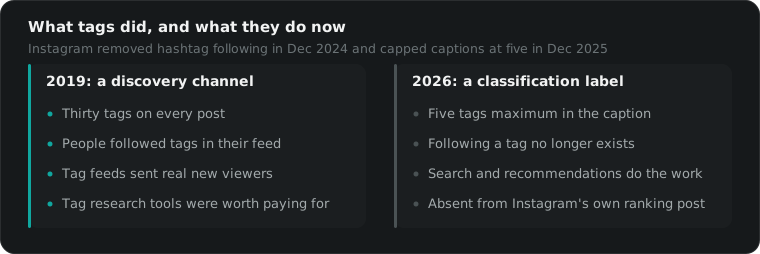
Hashtags on Instagram still work, but not as a reach mechanism. They label content so search and recommendations can classify it. Instagram capped captions at five hashtags from December 2025, and its own ranking explainer does not list hashtags as a signal anywhere. Thirty tags is 2019 advice.
Two changes did the damage. In December 2024 Instagram removed the ability to follow a hashtag, which killed the route by which tagged posts landed in strangers’ feeds. Then the cap arrived a year later.
The clearest evidence is what Instagram does not say. Adam Mosseri’s own post, Instagram Ranking Explained, walks through the signals used for Feed, Stories, Explore and Reels. Hashtags are not mentioned once. Your activity, the post’s engagement, and your history with the creator are.
So tags are metadata now. Useful metadata, worth two minutes, not worth a spreadsheet.
What is the Instagram hashtag limit now?
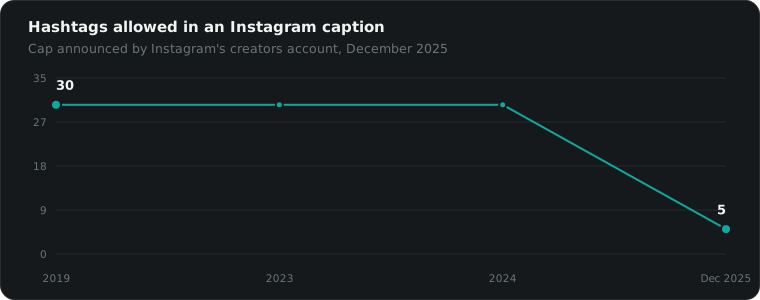
Instagram’s creators account said in December 2025 that captions for posts and reels would be limited to five hashtags, rolled out gradually. The stated reason was that fewer, more targeted tags perform better than many generic ones. Before that the cap was thirty, and most accounts dutifully used all thirty.
The rollout has been staggered, so you may still see accounts with more than five on older posts. Scheduling tools handled it badly for a few weeks, silently dropping tags past the fifth.
Practically, nothing changes for a well run account. If your tag list was ever thirty items long, it was never five relevant tags plus twenty five hopeful ones. It was twenty five hopeful ones.
The cap also ended a small industry. Tag research tools, rotating tag banks and the copy and paste blocks people kept in their notes app all existed to fill thirty slots. Five slots need no tooling. That is the real message in the change: Instagram does not want hashtags on Instagram used as a distribution hack, and it has now removed the room to do it.
1. Use five tags or fewer, and make every one specific
Five specific tags beat thirty broad ones, and now you have no choice anyway. Use tags a real person would search or follow: the product, the city, the category, the format. Drop anything with more than a few million posts, because a tag that size is a firehose nobody reads.
A workable set for a Riyadh coffee roaster is the roaster’s own name, the neighbourhood, the brew method, the city and the category. Five. Written once, reused forever, changed only when the content genuinely changes.
If you cannot explain what a tag is doing there, it is not doing anything there.
2. Pick tags by size, not by how popular they look
Tag size decides whether you are visible or buried. A tag with 400 million posts puts your reel behind everything, while a tag with 20,000 posts is small enough that your content sits near the top for a while. Mix three small tags with one medium one and stop there.
Instagram shows the post count when you search a tag. That number is the only research this needs.
| Tag size | What it usually is | What it does for you |
|---|---|---|
| Under 50,000 posts | Niche, city or product level | You stay near the top long enough to be seen |
| 50,000 to 500,000 | Category level | Some visibility, mostly inside that niche |
| 500,000 to 5 million | Broad category | Buried in minutes, occasional spillover |
| Over 5 million | Generic tags like love or fashion | Nothing useful. Spam and bots live here |
The row people ignore is the last one. Generic tags are what makes a comment section fill up with bot accounts, which is a real cost, not a neutral one.
3. Should hashtags go in the caption or the first comment?
Put them in the caption. Instagram has never confirmed any difference in reach between the caption and the first comment, and with a five tag cap there is nothing left to hide. The first comment trick existed to keep thirty ugly tags out of view. That problem no longer exists.
There is a small practical reason to prefer the caption too. Tags in the first comment depend on an automation firing correctly after publish, and when it fails nobody notices for a week.
Keep the caption readable. Tags go at the end, after the sentence that actually does the work.
One more thing that used to be treated as a rule. Nobody needs to hide hashtags on Instagram behind dots and line breaks any more, and the accounts still doing it are signalling that their advice is six years old. Five tags at the end of a caption look like a normal caption.
4. Match the tag to what is actually in the video
Tags are classification, so they should describe the content, not the audience you wish you had. If the reel shows a flat white being poured in Jeddah, tag the coffee and the city. Tagging a fashion week you did not attend gets the post shown to people who bounce immediately.
Bounces are worse than no reach. Instagram reads that as a signal the content did not deliver, and the next reel starts from a worse position. This is the one way hashtags on Instagram can still actively hurt you, and it is the opposite of what most tag advice tells you to do.
This is the same logic behind contextual advertising on the paid side. Match the message to the context and everything downstream gets cheaper.
5. Keep one branded tag, for collection and not for reach
A branded hashtag is a filing system, not a growth tactic. It collects customer photos, campaign entries and user content in one place you can find later, and it gives people something to type. Nobody discovers a brand through its own branded tag, so do not measure it that way.
Where a branded tag earns its keep is rights and sourcing. When you run micro-influencers, the tag is how you find every piece of content from a campaign in one search, months later, when you need it for an ad.
One tag. Short, spellable, not already in use by something embarrassing.
6. Move the effort to the hook, the caption and the audio
Hashtags on Instagram take two minutes. The first second of the video decides whether the reel travels, and the caption decides whether it gets saved and searched. Instagram ranks on watch time, sends, saves and comments, so those are the only inputs worth an hour of your week.
Write captions like search results, because that is what they have become. Say the thing plainly in the first line: what it is, where it is, who it is for. Instagram reads on screen text and audio too, so say it out loud in the video as well.
That is Instagram SEO in one paragraph. It is far duller than a tag strategy and it is what actually moves the numbers.
What we do with hashtags on Instagram on paid accounts
On paid accounts we treat hashtags on Instagram as housekeeping. Five relevant tags, written once per content pillar, then forgotten. The hours go into creative volume and into paid distribution, because a reel that works organically is also the cheapest ad you will run that month.
That last point is the one worth taking away. Organic reach on Instagram is a test bench, not a growth channel, in the same way Facebook marketing is now a paid channel with a page attached. When a reel earns saves and sends on its own, put money behind it and it usually stays cheap.
You can see what we charge before you speak to anyone, and 15 minutes is enough to work out whether your Instagram problem is really a hashtag problem. It almost never is.
Questions people actually ask
How many hashtags should I use on Instagram in 2026?
Five or fewer, because that is now the cap Instagram is rolling out on captions for posts and reels. Fewer than five is fine. Three specific tags that describe what is in the content will do more than five vague ones, and no number of tags will rescue a reel nobody watches past the first second.
Did Instagram really remove following hashtags?
Yes. Instagram removed the ability to follow a hashtag in December 2024, so tagged content no longer flows into anyone's feed through a followed tag. That change alone ended the main mechanism people were relying on when they added thirty tags to every post. Search and recommendations replaced it.
Do hashtags still help Instagram reels get reach?
Barely, and not in the way people think. Tags help Instagram classify what a reel is about, which feeds recommendations. They do not push a reel to a tag feed full of new viewers the way they did in 2019. Watch time, sends and saves decide whether a reel travels.
Should hashtags go in the caption or the first comment?
The caption. Instagram has never confirmed a reach difference between the two, and the first comment trick only existed to keep a wall of thirty tags out of sight. With a five tag limit there is nothing to hide, and tags in the caption are one less thing to automate and get wrong.
Are banned or broken hashtags still a real problem?
Less than the panic suggests, but it happens. Tags that attract spam or rule breaking content get restricted, and posts using them can stop appearing in that tag entirely. Check a tag by searching it before you use it. If the page shows no recent posts or a warning, drop it.
What replaced hashtags for getting found on Instagram?
Search and recommendations. Instagram now reads captions, on screen text, audio and the video itself to work out what a piece of content is about. That means a clear spoken sentence and a keyword rich caption do more for discovery than a tag list, which is closer to SEO than to hashtags.