Contextual advertising is back: what changed

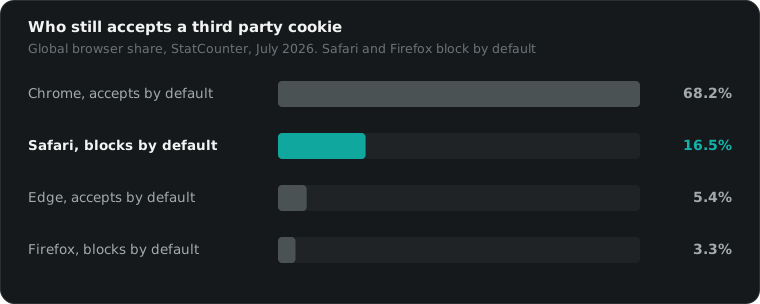
Contextual advertising targets the content of a page rather than the person reading it. It came back because Safari and Firefox block third party cookies by default, about a fifth of global browsing, and because Google retired ten Privacy Sandbox APIs in October 2025 with no replacement.
Contextual advertising is the practice of choosing where an ad runs based on what the page is about, rather than what the reader did last week. It is the oldest idea in advertising, and for about a decade the industry treated it as the thing you did when you could not afford better.
That changed, and not for the reason most articles give. The cookie did not die. Something more awkward happened: the replacement did.
What is contextual advertising, and how does it work now?
Contextual advertising matches an ad to the content of the page or video it appears beside, rather than to a profile of the reader. A running shoe ad next to a marathon training article. A hotel ad inside a destination guide. Modern systems classify that page with language models, not a keyword list.
The 2010s version was a keyword list. You gave the platform forty words, it matched pages containing those words, and your ad for garden furniture appeared next to a story about a body found in a garden. That failure mode is why the technique got a bad name.
The current version classifies pages with language models against a shared category list, and reads sentiment and page structure alongside the topic. The shared list is the IAB Tech Lab Content Taxonomy, which went from roughly 400 categories to over 1,500 in version 3.0 and reached 3.1 in December 2024. Video gets the same treatment through frame and transcript analysis.
The practical difference is that modern contextual targeting can tell the difference between an article about a crash and an article about a car launch. The 2015 version could not.
Why did contextual advertising come back?
Contextual advertising came back because the alternatives stopped working evenly. Safari and Firefox have blocked cross site cookies by default since 2020, which is roughly a fifth of global browsing. Chrome then kept its cookies after all in April 2025. Then Google retired ten Privacy Sandbox technologies in October 2025, the replacement included.
That is three things, in this order, and only the third one is a surprise. Safari blocked all cross site cookies by default in March 2020 and capped script written storage at seven days. Firefox followed with Total Cookie Protection. On StatCounter’s July 2026 numbers, behavioural targeting has been degraded on that slice of browsing for six years, quietly, while everyone argued about Chrome.
Then Google announced Chrome would deprecate third party cookies, and the whole industry spent five years building for that. In April 2025 Google reversed it, keeping third party cookies with no new prompt.
Then the surprise. In October 2025 Google retired ten Privacy Sandbox technologies, including Topics, Protected Audience, Attribution Reporting and IP Protection. So the cookie stayed and the standardised replacement went away. Contextual advertising is now the only addressability that works identically in every browser, in every app, and on every connected TV, because it does not depend on knowing who anyone is.
Where does contextual beat an audience?
Not everywhere. Contextual wins where there is no identifier to target: a first touch, connected TV, audio, and iOS app inventory where the user opted out. Audience data wins for retargeting a known visitor and for reaching a job title. Here is the split we actually use when planning a budget.
| Situation | Better signal | Why |
|---|---|---|
| First touch, no site history | Contextual | There is no identifier to target yet |
| Retargeting a cart abandoner | First party audience | You already know exactly who they are |
| Connected TV and audio | Contextual | No browser, no cookie, genre is the signal |
| High risk category adjacency | Contextual | Suitability is a page property, not a person property |
| Reaching a niche B2B title | First party or intent data | Job role is not visible in page content |
| In app inventory on iOS | Contextual | Opt out users carry no usable ad identifier |
The row people underuse is the first one. Most accounts spend nearly all of their non search budget talking to people who already know them, then wonder why growth stalled. Contextual advertising is how you buy the top of the funnel without pretending you have a profile you do not have.
Which platforms actually let you buy contextual targeting?
More than most people think, and you do not need a demand side platform to start. Google Display sells topics, content keywords and managed placements. YouTube sells topics, placements and content lineups. Connected TV sells genre, show and daypart. Meta is the exception, because a feed has no page to read.
Google Display gives you topics, content keywords and managed placements. Managed placements is the underused one: you name the sites, Google buys only those, and you get a placement report that tells you which ones worked. YouTube gives you topics, channel and video placements, and content lineups that group inventory by subject and suitability tier.
Meta is the exception. There is no page to read inside a feed, so the context is the feed itself. What you get instead is inventory filters and publisher blocklists on Audience Network, which is suitability control rather than targeting.
Connected TV is where context is the only signal there is. You buy a genre, a show, a network, a daypart. Nobody in CTV was ever disrupted by the cookie argument because nobody in CTV had a cookie.
Specialist contextual vendors sell page level classification and custom segments on top of a DSP. They are worth paying for at scale, and a waste of money below it, because the cheap version inside Google Ads answers the only question that matters first: does context move your numbers at all.
What does a good contextual buy look like?
Four decisions, in order. Buy moments rather than topics. Use an allowlist of sites you can name instead of the open exchange. Separate brand safety from suitability, because one is illegal content and the other is your own judgement. Then measure at placement level. Skip any of these and you get the 2015 experience.
- Pick moments, not topics. “Fitness” is a topic. “Someone reading a review of the shoe I compete with” is a moment. The second one converts and the first one is a reach number.
- Use an allowlist of sites you can name. A few hundred domains reach most of a target audience. Buying open exchange contextual across 44,000 domains reproduces every problem programmatic advertising has.
- Separate suitability from safety. Safety is illegal or harmful content, and every vendor blocks it. Suitability is whether a bank wants to sit beside a redundancy story. That judgement is yours, and it got harder after GARM shut down in August 2024 and took the industry’s shared framework with it.
- Measure at the placement level. Contextual buys live or die on which sites performed, and that report is the only thing that improves the next flight.
Then hold the creative to the same standard. A contextual placement is worth double when the ad references the context, and worth nothing when the same generic banner runs everywhere.
Where contextual advertising still fails
It will not tell you that the reader already bought from you last month. It cannot separate a purchase intent from idle curiosity on the same page. And it is easy to oversell, because vendors quote page level accuracy figures against their own classification, which is close to marking your own homework.
Contextual advertising also does nothing for measurement. Knowing an ad ran beside the right article does not tell you it caused a sale. That still needs the advertisement tracking work, and it still needs a sensible view of audience targeting for the people who come back.
The honest position is that contextual is a placement decision, not a measurement strategy. Anyone selling it as both is selling you a dashboard.
There is a regional problem on top of that. Page classification is trained overwhelmingly on English, and Arabic classification is noticeably weaker, worse again on dialect and on transliterated Arabic written in Latin script. In practice a vendor’s category accuracy in Riyadh is not the number in its English case study. We test that before we commit budget by running a small allowlist buy and reading the placement report, rather than trusting a segment name.
What we do about it
We use contextual advertising for the part of the budget that has to reach strangers, and owned signals for everyone else. On most MENA accounts that means contextual and broad social carrying discovery, then search and retargeting closing. The split sits near seventy thirty in favour of discovery after month three.
The reason is simple. A retargeting pool stops growing before the business does, so an account that leans on it looks efficient for a quarter and then stalls.
You can see what that costs before you talk to us, including the exact percentage at your spend level. If it is easier to just ask whether contextual advertising is worth a line in your plan, 15 minutes will settle it.
Questions people actually ask
What is the difference between contextual and behavioural targeting?
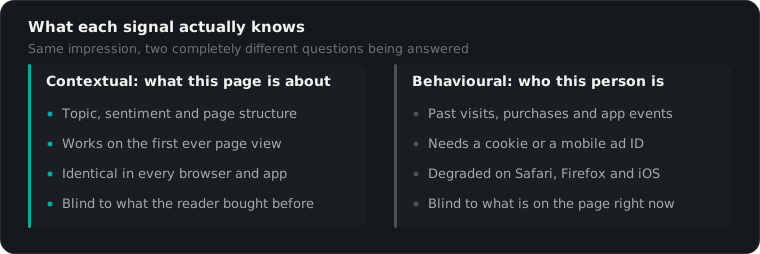
Contextual targeting decides where an ad runs based on what a page is about. Behavioural targeting decides who sees it based on what that person did previously, which needs an identifier such as a cookie or a mobile ad ID. Contextual needs no identifier, works on the first page view, and does not degrade when a browser blocks tracking.
Is contextual advertising better than cookie based targeting?
Not better, different. Contextual is stronger for reaching people in a buying moment on unaddressable inventory, and for brand suitability. Cookie and first party targeting is stronger for retargeting a known visitor and for measuring what happened afterwards. Most accounts should run both, with contextual carrying the top of the funnel and owned signals carrying the rest.
Can I do contextual targeting in Google Ads without a DSP?
Yes. Google Display campaigns offer topics, keyword content targeting and managed placements, all of which are contextual. YouTube offers topics, placements and content lineups. None of these require a demand side platform or a seat fee, so they are the cheapest way to test whether contextual works for your product before paying for a specialist vendor.
Does contextual advertising work on connected TV?
Yes, and it is often the only signal available. Connected TV has no browser and no cookie, so buys are made against genre, show, network, daypart and household level data rather than an individual profile. That is contextual by another name, which is why CTV buyers were never disrupted by the cookie debate in the first place.
What is a content taxonomy and why does it matter?
A content taxonomy is the shared list of categories used to describe what a page is about, so buyers and sellers mean the same thing by a label. The IAB Tech Lab Content Taxonomy is the industry standard, expanded from roughly 400 categories to more than 1,500 in version 3.0 and updated to 3.1 in December 2024.