Facebook marketing in 2026: it is a paid channel

Facebook marketing in 2026 is a paid channel. Organic reach on a business page runs around 2 to 5 percent of followers on the accounts we run. The page is social proof and the place a paid click lands. Growth comes from budget, creative volume and clean conversion tracking.
Facebook marketing used to mean posting to a page and hoping people saw it. That stopped working around 2016, and pretending otherwise still costs brands real money every month.
The honest version in 2026 is short. Facebook is a paid channel. The page still matters, just not for the reason most people think it does.
Is organic Facebook marketing dead in 2026?
Organic Facebook marketing is effectively dead for business pages. On the accounts we run, an unpaid page post reaches roughly 2 to 5 percent of followers, and most of that is people who already bought. Facebook ranks the feed by predicted engagement, and a promotional page post loses that competition every single time.
It is not a conspiracy. There is more content than feed, so ranking is the only option, and the feed now competes with recommended video from accounts you do not follow. A page post has to beat all of that on predicted watch time and comments. It rarely does.
The money tells the same story. Meta’s second quarter 2026 results report ad impressions up 14 percent year over year and average price per ad up 12 percent. Impressions are being sold, not given away, and they are getting more expensive.
So the practical question is not how to beat the algorithm with better organic posts. It is how much you are willing to pay for attention, and what you do with it when it arrives.
What is a Facebook business page actually for?
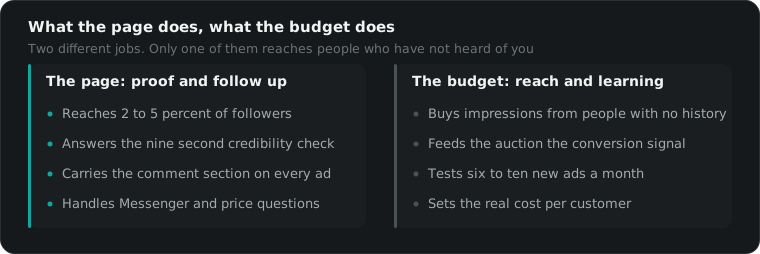
A Facebook business page is not a distribution channel any more. It is the profile a paid click lands on, the proof a buyer checks before spending money, and the inbox where the awkward questions arrive. Treat it as a shopfront that has to look open, not as a publishing schedule you are obliged to feed.
Three jobs, in order of how much money they move.
First, credibility. Someone sees your ad, taps the page name, and spends nine seconds deciding whether you are a real business. A page with no posts since 2023 answers that badly.
Second, the destination. Every ad carries your page identity. The name, the photo, the follower count and the last post all sit inside the ad unit.
Third, the inbox. Messenger and comment replies are where the sale gets closed in Gulf markets far more often than anyone plans for.
Posting three times a week is enough to do all three. Posting daily to chase reach that does not exist is unpaid work.
Where does the money actually go in Facebook ads?
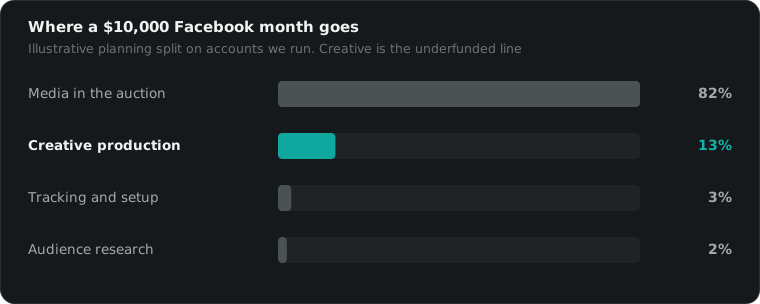
Most of a Facebook marketing budget goes into the auction, but most of the result comes out of the creative. On a $10,000 month we would expect about 85 percent of the cash in media and the rest in production. Targeting is now the smallest lever on the board, and it is the one everyone still argues about.
Here is the split we plan against on a $10,000 monthly budget. Treat the shares as illustrative, because product margin moves them.
| Line | Share of the month | What it actually buys |
|---|---|---|
| Media in the auction | 80 to 85 percent | Impressions, and the data the auction learns from |
| Creative production | 10 to 15 percent | New hooks, new angles, enough volume to test |
| Tracking and setup | One off, then small | Conversions API, events, exclusions that work |
| Audience research | Almost nothing | Broad plus a few exclusions beats a hundred interests |
Advantage+ and broad targeting have eaten the part of the job that used to feel clever. You are no longer picking interest stacks. You are feeding the system conversion signal and creative, and the accounts that win are the ones producing more usable ads per month, not better spreadsheets.
That is why tracking sits above audiences on that list. If your events are wrong, the auction optimises toward the wrong people and no amount of targeting rescues it. Meta’s Conversions API is the server side piece most accounts either skip or install badly, and it is worth doing properly before you spend another dirham.
What does a lead actually cost on Facebook in MENA?
Costs vary more by category than by country. As an illustrative range from accounts we run, a simple lead form in the Gulf lands somewhere between $2 and $12, a qualified booked call is several times that, and an ecommerce purchase depends almost entirely on price point. Anyone quoting one number for the region is guessing.
Three things move the number more than the market does.
The offer. A form asking for a name and a phone number is cheap and mostly noise. A form asking three qualifying questions costs more per lead and less per customer.
The creative. The gap between the best and worst performing ad in the same account is routinely three or four times on cost per result. That gap is bigger than anything targeting will give you.
The follow up. In Saudi and the UAE, a lead called back within five minutes converts at a completely different rate than one called the next day. That is not a media buying problem, and no ad account can fix it.
How do you set up Facebook marketing that grows a business?
Six steps, in this order, and the order is the point. Fix tracking, pick one conversion event, build one broad campaign, produce more creative than feels reasonable, read the results at the ad level, then decide what to kill. Most accounts we audit have done step three and skipped the other five entirely.
- Fix tracking first. Pixel plus Conversions API, with deduplication, and a test purchase you can watch arrive in Events Manager. Everything downstream depends on this.
- Pick one conversion event. Purchase, or qualified lead. Not both. An account optimising for two things optimises for neither.
- Build one broad campaign. Broad targeting, a handful of ad sets at most, and exclusions for existing customers. Resist the urge to segment by governorate.
- Ship creative in volume. Six to ten new ads a month, in different formats, saying genuinely different things. This is the job now.
- Read results at the ad level. Cost per result by creative, not by audience. Then brief the next round from what won.
- Kill things on a rule, not a feeling. Write down the cost per result at which an ad comes off. Then actually do it.
Step four is where almost everyone stalls, because it is the only one that needs a camera and a person willing to be on it. If you are choosing between a better targeting setup and one more week of shooting, shoot.
Why the comment section decides the sale
The comment section under a Facebook ad is read by people who are close to buying, and it is the one part of Facebook marketing that brands consistently ignore. Unanswered questions, a two year old complaint, or spam sitting at the top of an ad with real spend behind it will quietly cost you more conversions than any bidding mistake.
Comments carry across every ad using the same post ID, which is why consolidating creative into one post ID is worth doing. Social proof accumulates. So do the arguments.
Two rules. Answer every price question with the price. Hiding it and asking people to DM reads as expensive and evasive, and in Gulf markets it reads as a bad sign specifically.
Then hide, do not delete, the abuse. Deleting starts a fight. Hiding removes it for everyone else while the person who wrote it still sees it there.
This is also where micro-influencers earn their fee, because a creator’s own audience will defend a claim in a way your brand account never can.
What we do about it
We run Facebook marketing as a paid channel with an organic page attached, not the other way around. That means budget against one conversion event, tracking rebuilt properly on day one, and a creative pipeline that produces enough ads for the auction to have something to choose between each week.
We also say the awkward part on the first call. Under about $2,000 a month of spend, there is not enough conversion data for anyone to optimise against, and paying a fee on top makes your maths worse. Run it yourself and come back when it hurts.
If it is above that, you can see exactly what we charge before you speak to anyone, including what the percentage works out to in real money. There are accounts and what they returned if you would rather see the work first, and 15 minutes is usually enough to tell whether Facebook marketing is even the right channel for what you sell.
Questions people actually ask
Is Facebook marketing still worth it for a small business?
Yes, but only as a paid channel with a real budget behind it. Below roughly $2,000 a month of spend you will not get enough conversions for the auction to optimise, and you are better off running it yourself than paying anyone to manage it. Above that, Facebook is still the cheapest way to reach a broad consumer audience in most MENA markets.
How often should a business page post organically?
Two or three times a week is enough. The point is not reach. The point is that a person who clicks your ad, lands on the page and scrolls sees a business that is clearly still trading. An empty page or one whose last post is from 2023 kills conversion rate more effectively than any bad targeting.
What is a realistic Facebook ads budget to start with?
Aim for at least 30 to 50 conversions a month, then work backwards. If your cost per purchase is $20, that is $600 to $1,000 of spend. If it is $60, you need $1,800 to $3,000. Starting below the number the auction needs to learn is the most common and most expensive mistake we see.
Do boosted posts work?
Boosting buys reach and engagement on a post that already exists. It does not buy a purchase, because the objective and the optimisation are wrong for that. Boosting is fine for filling a comment section with real activity before a launch. It is not a substitute for a campaign built in Ads Manager against a conversion event.
How much should an agency charge to run Facebook ads?
Most charge 10 to 20 percent of ad spend or a retainer of $2,000 to $10,000 a month. Ask what the percentage works out to in real money at your budget before you sign anything. Our own rate starts at $1,095 flat under $2,500 of monthly spend and lands at 10.4 percent all in at $50,000.