Digital marketing plan: how to write one that works

A digital marketing plan starts with one number: what a customer is allowed to cost, taken from gross margin. Everything else follows from it. Google recommends judging a campaign on at least 30 conversions in 30 days, so that same number sets the smallest budget the plan can honestly ask for.
A digital marketing plan is mostly arithmetic, and the reason so many of them are useless is that the arithmetic is missing. What is there instead is a market overview, a SWOT, four personas with stock photo faces, and a channel list with no budget attached to any of it.
Here is the version I would write for a client, in the order I would write it. It is short on purpose. Every line in it is a commitment somebody can be held to in month four.
What should a digital marketing plan actually contain?
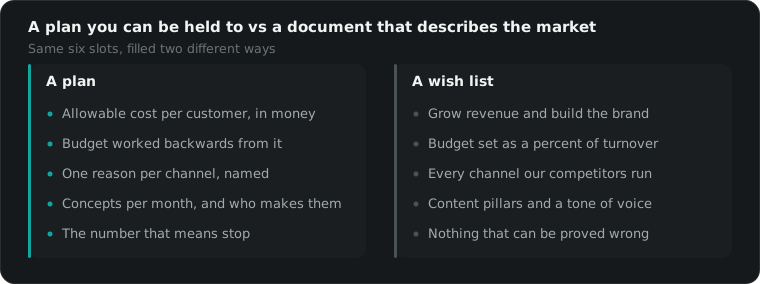
Six sections in a digital marketing plan: what a customer is allowed to cost, the budget that follows from it, the channels with one reason each, creative volume and who makes it, how a conversion gets counted, and what would make you stop. If a section does not change a decision, it does not go in.
- What a customer is allowed to cost. One number, taken from margin, not from ambition.
- The budget that follows from it. Worked out backwards from the number above, not set as a percentage of revenue.
- The channels, with one reason each. Including the ones you are deliberately not running this year.
- Creative volume and who makes it. How many concepts a month, and the name of the person producing them.
- How a conversion gets counted. What is tracked today, what is broken, who fixes it and by when.
- What would make you stop. The number at which budget comes out of a channel.
That last one is the difference between a plan and a wish list. If nothing in the document can be proved wrong, nothing in it can be proved right either.
What cost per acquisition can you actually afford?
Take the gross margin on an order, not the revenue, then multiply it by how many times a customer buys in a year. That figure is the ceiling. Your allowable cost per acquisition is the share of it you are willing to hand to the ad platforms, and every digital marketing plan starts there.
| Line | Worked example | Why it matters |
|---|---|---|
| Average order value | $80 | Revenue, and the number most people stop at |
| Cost of goods, shipping, payment fees | $38 | The part that never appears in the deck |
| Gross margin per order | $42 | What is actually available to spend |
| Orders per customer in 12 months | 1.4 | Changes the answer more than any tactic will |
| Gross margin per customer, year one | $58.80 | The real ceiling |
| Allowable cost per new customer | $42 | Pay back on the first order, stay solvent |
Illustrative numbers, but the shape is real. Notice that the repeat rate moves the ceiling by 40 percent, which is more than any bidding change you will make all year. If a client cannot tell you their repeat rate, finding it is deliverable one, and it is worth more than the campaign.
Two things break this in practice. Clients who quote net margin after salaries, which leaves nothing for media. And clients who quote lifetime value over five years, then run out of cash in month seven.
How much budget does a digital marketing plan need?
Work backwards. Allowable cost per customer, times the number of customers you want a month, is the budget in a digital marketing plan. Then check that answer against a floor of 30 conversions a month, which is what Google recommends before judging a campaign. If it cannot buy 30, it is not measurable.
The floor is measurement, not ambition. Google’s own guidance on Target CPA bidding recommends evaluating performance over a period containing at least 30 conversions. Below that, the difference between a good week and a bad week is noise, and you will be making decisions on nothing.
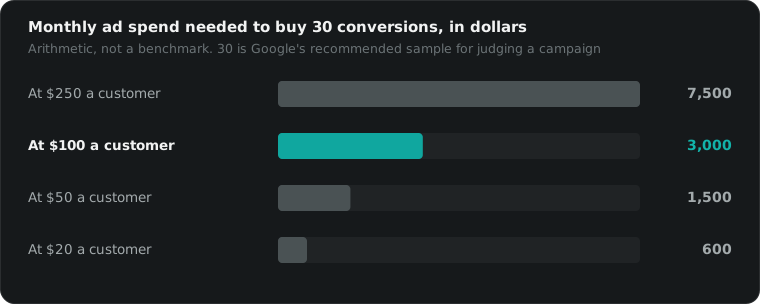
So if a customer costs you $100 to acquire, the smallest honest budget in the plan is $3,000 a month, per channel, before fees. If a customer costs $250, it is $7,500. This is the calculation that decides whether a business should be running paid media at all, and almost nobody does it before they start.
Under about $5,000 a month total, the answer is usually to pick one channel, run it yourself for a quarter, and revisit. We say that on calls and it costs us work. It is still the right answer.
One regional caveat. In markets where cash on delivery is normal, count delivered orders, not placed ones, when you set that budget. A plan built on placed orders in Iraq or Egypt overstates what the money bought, and the gap shows up as an unexplained margin hole in month three.
How many channels should the plan run?
Fewer than you want. One channel, run properly, until it is profitable. Two once the first has stopped teaching you anything new. Rarely more than three below $50,000 of monthly spend. The limit is not focus, it is conversion volume, because every platform’s bidding model needs events to train on.
Do the division and it stops being a matter of taste. Split $6,000 across four platforms and each one gets $1,500, which at a $100 cost per acquisition is 15 conversions a month. Nothing learns anything. You then spend six months concluding that all four platforms are mediocre, when what was mediocre was the budget per platform.
Write the excluded channels into the plan by name. “No LinkedIn in 2026, because our buyer is not researching this at work” is a sentence that saves an argument in April.
What does the measurement section have to say?
It has to say what is broken now, who fixes it, and by when. Every account has something broken, and the plan is the only moment when saying so counts as information rather than an excuse. It also has to name the single number the plan will be judged on.
The common ones. A pixel firing on page load instead of purchase, so every add to cart counts. A checkout on a separate domain that drops the session. Server side tracking that was never set up, so iOS traffic looks like it converted at half the rate it did. Meta’s own Conversions API documentation is the reference for the last one, and it is the single most common gap I find in accounts that arrive saying performance dropped and nobody knows why.
Then say the uncomfortable part in writing. Platform reported conversions and the client’s back office will not match. State roughly by how much, and state which number the plan is judged on. Pick one. Usually it is the back office.
How do you know when the plan is wrong?
You wrote down what would make you stop, so check the digital marketing plan against that number every month. That is the whole mechanism. Beyond it, watch three signals: flat volume at a stable cost, rising costs while volume holds, and platform numbers that look fine while revenue does not move.
Beyond that, three signals. Cost per acquisition is stable but volume will not grow, which means you have saturated the demand that already existed and the plan needs something upstream of search. Costs rise while volume holds, which is usually creative fatigue rather than an auction problem. And the platform numbers look fine while revenue does not move, which is an attribution problem you should have flagged in section five.
A digital marketing plan is not a forecast. It is a set of decisions with numbers attached and a rule for when to change your mind.
What we do with it
We write the plan in one conversation and one page, then spend the rest of the time on the part that decides outcomes. If you want that half, media buying covers what happens daily, and a social media marketing proposal is the document that turns the plan into a scope somebody signs.
Our pricing is published in full, so you can put a real fee line into your digital marketing plan before you speak to anyone. If the arithmetic above says your budget cannot buy 30 conversions a month yet, keep the plan and skip the agency for now. When it can, 15 minutes is usually enough to say whether the plan holds.
Questions people actually ask
What should a digital marketing plan include?
Six things: what a customer is allowed to cost, the budget that follows from that number, the channels and one reason each is on the list, how much creative is needed and who makes it, how conversions are tracked, and what would make you stop. Everything else is context, not plan.
How long should a digital marketing plan be?
Two pages, plus a budget table. The value is in the decisions, not the document. If a plan runs forty slides, most of those slides are describing the market rather than committing to anything. A plan that cannot be summarised on one page has not finished being written.
How do you set a marketing budget in a plan?
Work backwards. Take your allowable cost per customer, decide how many customers you want a month, and multiply. Then check the answer against 30 conversions a month, which is Google's own recommended sample for evaluating a campaign. If the budget cannot buy 30, the plan will not be measurable.
How many channels should a digital marketing plan include?
One to start, two once the first is profitable, and rarely more than three under 50,000 dollars of monthly spend. Splitting a small budget across four platforms gives none of them enough conversion volume to optimise against, and every platform's model needs volume before it does anything useful.
How often should the plan be rewritten?
Quarterly, and only the parts that broke. Budgets and creative get reviewed every quarter. The allowable cost per customer only changes when pricing, margin or repeat rate changes. Rewriting the whole document every month is a sign the numbers in it were never real.
What is the difference between a marketing plan and a media plan?
A digital marketing plan covers the whole commercial picture: the offer, the pricing, the margin, the channels and the measurement. A media plan is the subset that decides where paid budget goes and why. The media plan sits inside the marketing plan and should never contradict it.