Micro-influencers: cost and what to ask for

Micro-influencers are creators with roughly 10,000 to 100,000 followers. In MENA we pay between $150 and $2,000 per deliverable depending on market and category. The fee is not the deal. Whitelisting their handle so you can run their post as your own ad is worth more than the post.
Micro-influencers are the line of the budget most brands hand to an intern, and it is the line with the widest spread between a good deal and a terrible one. The difference is rarely the fee.
14 years of paying for this and measuring it has left me with a short list of things that matter and a long list of things that do not. Follower count is on the second list.
What are micro-influencers, and do they actually work?
Micro-influencers are creators with roughly 10,000 to 100,000 followers who post to a specific interest rather than a general audience. They work, but not for the reason usually given. The value is not their reach, it is that their content converts when you put paid budget behind it.
The reach argument falls apart quickly. A creator with 40,000 followers might get 6,000 views on a post. Buying those same 6,000 views as impressions costs very little. If you are paying $500 for the post, you are not buying media, you are buying a piece of content and a name attached to it.
Which is fine, as long as you know that is the purchase. It changes what you negotiate for and it changes how you measure it.
What do micro-influencers charge in MENA?
Micro-influencers in MENA charge anywhere from a free product to about $2,000 per deliverable, and the spread is mostly market and category, not follower count. As an illustrative range from accounts we run, a 30,000 follower creator in Riyadh costs several times the same size creator in Cairo.
Saudi and the UAE sit at the top, partly because of licensing costs and partly because brand budgets there set the price. Egypt and North Africa sit well below. Lebanon and Jordan sit in between and negotiate hardest.
Treat the table below as illustrative planning ranges from accounts we run in the Gulf and the Levant, not a rate card. Categories like beauty and finance run above these numbers, and food runs below.
| Creator size | Followers | Fee per deliverable, illustrative | Usually includes |
|---|---|---|---|
| Nano | 3,000 to 10,000 | Product only, up to $150 | One reel or one story set |
| Micro | 10,000 to 50,000 | $150 to $600 | One reel, two stories, a link |
| Upper micro | 50,000 to 100,000 | $400 to $1,200 | Reel, stories, sometimes a static |
| Macro | 100,000 and above | $1,500 and up | Negotiated per campaign |
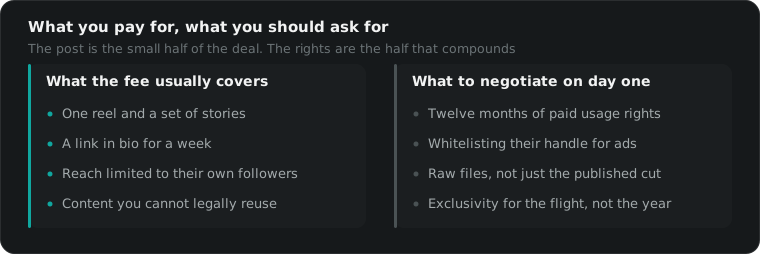
Two things get negotiated far more than the headline fee: usage rights and exclusivity. Both change the number more than another 10,000 followers ever will, and both are where an inexperienced buyer loses money without noticing.
Why is follower count the worst predictor of results?
Follower count is the worst predictor of results because reach on Instagram and TikTok is decided by watch time and shares, not by how many people follow an account. A creator with 12,000 followers whose reels are watched to the end will out deliver one with 90,000 followers who bought them.
This is not a theory. Instagram’s own ranking explainer lists your activity, the post’s engagement signals and your history with the creator. Follower count is a weak input at best, and it is not what decides whether a reel gets recommended.
So ask for different numbers. Average views over the last ten reels, not the best one. Saves and sends. Watch time if they will screen record it. Story reply counts, which are almost impossible to fake and tell you whether anyone actually listens to this person.
The other reason follower count misleads is that it is the one number an audience can be bought for. Everything else on that list costs more to fake than it is worth.
How does whitelisting a creator handle work?
Whitelisting is when a creator gives your ad account permission to run ads from their own handle. The ad shows their name and their face, not your brand page, and you control the budget, the targeting and the landing page. On Meta this is set up through partnership ad permissions.
This is the real unlock, and most brands never ask for it. The same video run from the creator’s handle usually beats the version run from the brand page, because the profile picture, the name and the comment section all read as a person rather than an advertiser.
It also fixes the biggest weakness of micro-influencers, which is that their organic reach is small. Whitelisting lets you take a post that reached 6,000 people and put it in front of 600,000, with your own targeting and your own tracking, and pay media rates to do it.
Ask for it in the first conversation, before the fee is agreed. Asked afterwards, it becomes a paid extension. Asked as part of the original deal, it is often free or close to it, because the creator has no idea what it is worth either.
What should be in the contract, and who owns the content?
Four things belong in every micro-influencer contract: what gets delivered and by when, how long you may use the content in paid ads, whether you may run it from the creator’s handle, and what exclusivity you are buying. Leave usage rights out and you will pay twice for the same video.
Default position: twelve months of paid usage across all platforms, whitelisting included, and category exclusivity for the length of the campaign only. Expect to pay 20 to 50 percent above the content fee for the usage term.
Exclusivity is where brands overpay. A year of category exclusivity from a creator with 20,000 followers is not worth what it costs. Buy it for the flight and let it lapse.
Disclosure goes in the contract too. Use the platform’s paid partnership label every time, not a buried hashtag. The FTC’s guidance for influencers is the clearest published version of the rule, and several Gulf markets now add a licensing requirement on top of it.
How do you tell if the numbers are bought?
Bought numbers are common and easy to spot once you know the pattern. Ask for a screen recording of the account insights, not a screenshot. Then check three things: where the audience actually lives, whether saves and shares track with the view count, and whether the comments read like real people.
Audience location is the fastest tell. A Jeddah lifestyle account with 40 percent of its audience in Indonesia or Brazil has bought something at some point.
The second tell is shape. Real accounts have spiky view counts, because some posts work and most do not. An account where every post lands within a few percent of the same number is being topped up.
The third is the comment section. Generic praise and emoji arriving in a tight cluster minutes after posting is a pod or a service. Real comments answer the video, argue with it, or ask the price. The same rule applies to hashtags on Instagram, where generic tags pull in exactly this kind of noise.
None of this means walk away automatically. Plenty of decent creators bought followers once, years ago, and are embarrassed about it. It means price the deal on the real numbers, not the vanity one.
What we do about it
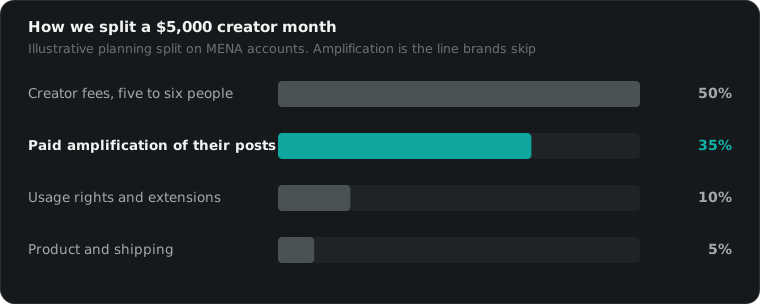
We run micro-influencers as a creative supply line for paid media, not as a reach buy. Fee, usage rights for twelve months and whitelisting agreed up front, then the content goes into the ad account and the numbers decide which creator gets booked again next month.
In practice that means booking five or six small creators instead of one large one, briefing them on the angle rather than the script, and accepting that two of the six will produce something that beats everything else in the account. That is the point of the volume. It is the same logic as a creative pipeline for Facebook marketing, and it sits inside the same media buying budget rather than beside it.
The awkward part: if your total monthly spend is under about $3,000, do not run micro-influencers at all. Put it into ads, learn what message works, then buy creators to make more of that message.
If you are above it, you can see what we charge before you speak to anyone, and there are accounts and what they returned if you want the work first. 15 minutes is usually enough to work out whether micro-influencers belong in your plan this quarter or the next one.
Questions people actually ask
How many followers does a micro-influencer have?
Roughly 10,000 to 100,000. Below that the industry calls them nano-influencers, above it macro. The bands are conventions, not rules, and nobody enforces them. What matters more than the band is whether the account's views and saves move together, because that is the part a brand is actually buying.
Are micro-influencers cheaper than macro-influencers?
Per post, yes, often by ten times. Per result, not automatically. Ten small creators cost ten briefs, ten contracts and ten sets of chasing, and that time is real. The reason to use them is content volume and credibility in a niche, not the headline fee being smaller.
What is whitelisting, and why does it matter?
Whitelisting means the creator authorises your ad account to run ads from their handle. The ad carries their name and face while you control budget, targeting and the landing page. It usually outperforms the same creative run from a brand page, and most brands never think to ask for it.
How long should usage rights last?
Ask for twelve months of paid usage across all platforms as a default, and expect to pay between 20 and 50 percent on top of the content fee for it. Six months is common. Anything under three months means you will be renegotiating for a video that is finally starting to work.
How do I check whether an influencer bought their followers?
Ask for a screen recording of their insights rather than a screenshot, then look at audience country, the ratio of saves and shares to views, and the comments. Real comments answer the video. Bought ones are emoji and generic praise arriving in a cluster within minutes of posting.
Do influencers in MENA have to disclose paid posts?
Rules vary by country, and several Gulf markets now require an influencer licence. Disclosure is also platform policy and, for anything reaching US audiences, an FTC requirement. The practical answer is to disclose every time. A visible paid partnership label costs almost nothing in performance.