Persuasive advertising, with real examples

Persuasive advertising changes behaviour, not just opinion. It works by attaching a brand to a moment the buyer already recognises, then repeating it until the link is automatic. The Snickers hunger campaign did exactly that across 58 markets and lifted sales 15.9 percent in a year.
Persuasive advertising is advertising built to change what someone does, not just how they feel about you. That distinction sounds academic right up until you are the one paying for it.
Most of what gets called persuasion is decoration. A clever line, a nice film, a founder telling you why they started. Some of it sells. Most of it gets watched and forgotten by lunchtime. The difference is rarely craft. It is whether the ad attached itself to a moment the buyer already has.
What is persuasive advertising?
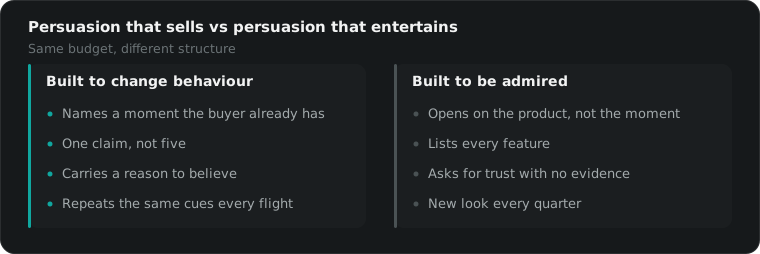
Persuasive advertising moves a specific person toward a specific action, using a reason they already accept. Informative advertising tells you a product exists. Persuasion tells you why this one, now, instead of the one you nearly bought. Every version of it has the same three parts: a trigger, a claim, and a reason to believe.
Here they are, in the order they matter.
- A trigger. The moment in real life where the need shows up. Hungry at 3pm. Card declined abroad. Third late delivery this month.
- A claim. One thing the product does about that moment. One. Not five.
- A reason to believe. A demonstration, a guarantee, a number, a face, a queue outside the door.
Skip the trigger and you have made an ad about a product. Include it and you have made an ad about the buyer’s Tuesday. Only one of those gets remembered at the moment of purchase.
Which persuasive advertising techniques actually move sales?
Six advertising techniques survive contact with a real media buy: social proof, scarcity, authority, reciprocity, loss framing and familiarity. Social proof is the cheapest of them and the most underused. Familiarity is the most underrated, because it costs nothing and it compounds. The academic list of persuasion levers is far longer and mostly does not pay.
| Lever | What it looks like in an ad | Does it hold up in paid media |
|---|---|---|
| Social proof | Review counts, customer numbers, visible queues | Yes. Cheapest lever available and almost always underused |
| Scarcity | Deadlines, limited stock, closing enrolment | Yes, once. Fake scarcity gets found out and kills repeat purchase |
| Authority | Expert on camera, certification, published test | Yes, in considered purchases. Wasted on impulse products |
| Reciprocity | Free tool, sample, genuinely useful content | Slow. Works on high value, long cycle sales |
| Loss framing | What you lose by not acting | Strong in insurance and finance, tiresome everywhere else |
| Familiarity | Same character, sound, colour, line, every time | The most underrated. Costs nothing and compounds |
The last row is the one most brands throw away. They change the whole look every quarter because the team got bored, then wonder why cost per purchase creeps up. Familiarity is a persuasion lever, and it is free, and rebranding resets it to zero.
The row people abuse is scarcity. A countdown timer that resets when you reload is not persuasive advertising, it is a lie with a stopwatch on it. It works exactly one time per customer.
What does persuasive advertising look like in a real campaign?
The clearest example of persuasive advertising in a real campaign is Snickers, and it is not a beautiful film. From 2010 the work welded the product to a trigger everyone already has, which is being unbearable when hungry. No product features. No claim about chocolate. Just a moment, and a line about that moment.
What it sold was a punchline you can run for a decade without changing it, attached to a need that turns up every afternoon.
The IPA’s published case study reports that the work grew sales 15.9 percent in a year, took market share in all but two of the 58 markets it ran in, and added US$376.3 million in global market share. You can read the IPA case study yourself. That is a rare thing in advertising: a persuasion claim with an audited number attached to it.
What made it work was not the celebrities. It was that the same idea could be reshot in 58 markets without translation, and that it named a moment rather than a product benefit. Most brands try to own an adjective. Snickers owned a feeling at 4pm.
How do you know the persuasion worked?
You do not know, unless you ran a holdout. Keep a slice of the audience out of the campaign, then compare purchase rates against the group that saw it. If both buy at the same rate, the ad persuaded nobody and took credit for sales that were coming anyway. Almost every account we take over has never run that test.
Platform reporting tells you which ad got attributed to the most purchases. It does not tell you whether those people would have bought anyway. Retargeting an existing customer who already had your product in their basket is not persuasion. It is bookkeeping with a media budget attached.
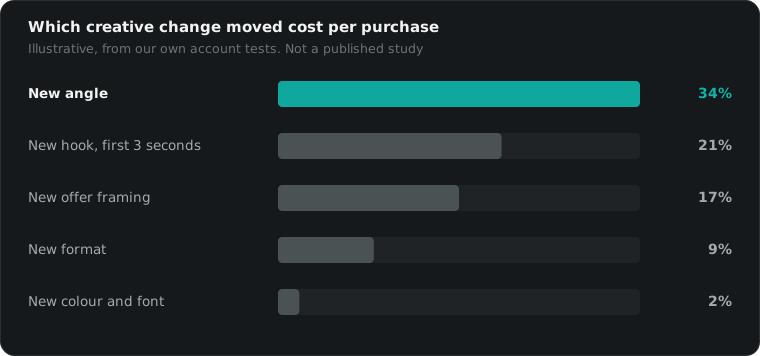
We run holdouts on accounts above roughly $20,000 a month. Below that the sample is too small to read, and you are better off judging creative on cost per purchase and moving on. Ad creative testing at small budgets is a comparison, not an experiment, and pretending otherwise wastes a quarter.
The second test is cheaper and nearly as useful. Change one thing at a time. Angle, then hook, then offer framing, then format. In our own tests the angle moves the number far more than the font ever will, and yet the font is what gets debated in the meeting.
When does persuasion become a compliance problem?
Persuasion becomes a compliance problem when the claim needs the audience not to check. The line is substantiation, not taste. If you say fastest, you need a test to point at. If a creator says they love the product and you paid them to say it, that connection has to be visible in the ad itself.
The rules are published and they are short. The FTC’s Endorsement Guides, revised in 2023, are explicit that a material connection a significant minority of consumers would not expect must be disclosed clearly and conspicuously. Buried hashtags do not count.
This matters commercially, not just legally. An ad that gets pulled after four days has spent your production budget and bought you nothing. We have seen accounts lose a fortnight of learning phase to a single unsubstantiated claim in a hook.
Does persuasive advertising work differently in the Gulf?
Yes, and three things decide it: dialect, proof and timing. Pick one Arabic dialect and commit to it, because Modern Standard reads like a government notice. Use a named face rather than an aggregate star rating. And treat Ramadan as a different daily rhythm, not a seasonal bump you slot into a calendar.
Dialect first. A lot of brands run one Arabic version and one English version and call it localised. In Saudi and the UAE the winning creative is usually the one that picks a dialect and commits, because Gulf Arabic and Egyptian Arabic land very differently. We have watched the same offer swing on nothing but which dialect the voiceover used.
The second is proof. Social proof carries more weight per unit than it does in the US or the UK, and it wants a face and a name rather than an aggregate star rating. A screenshot of a real WhatsApp message from a customer will outperform a polished testimonial film often enough that we now shoot for it deliberately.
The third is timing. Persuasive advertising built for a 9am commute does nothing at 9am during Ramadan. Cost per thousand impressions climbs, attention shifts to late evening, and the brands that budget for the whole month at a flat daily rate burn the first ten days learning that.
None of this is exotic. It is the same three parts, trigger, claim, reason to believe, pointed at a different Tuesday.
Where this fits in a real budget
Persuasive advertising is a creative problem that gets solved with media money, which is why the two cannot be separated. The best script in the world dies in a badly built account, and the best account structure cannot save an ad that gives nobody a reason.
If you want the wider map, we have written up the main types of advertisements and where each one earns its place, and a harder look at controversial ads and what actually happened to the brands that ran them.
What we do is unglamorous. Two or three genuinely different angles a month, tested against each other, with the losers cut and the winner rebuilt rather than retired. You can see exactly what that costs before you speak to anyone, and there are real accounts and what they returned if you want the work before the conversation. Below about $5,000 a month, honestly, you will learn more running persuasive advertising yourself for a quarter than paying anyone to run it for you.
Questions people actually ask
What is the difference between persuasive and informative advertising?
Informative advertising tells you a product exists and what it does. Persuasive advertising gives you a reason to choose it now, over the alternative you were about to pick. Most real ads do both, but the split matters for measurement. Informative work is judged on reach and recall. Persuasive work is judged on whether sales moved among people who saw it.
Does persuasive advertising still work on people who know they are being sold to?
Yes, and it always has. Awareness of the technique does not switch off the response to it. A queue outside a restaurant still reads as a signal of quality even when you know the restaurant may have staged it. What does stop working is persuasion that depends on the audience not checking. Anything a buyer can verify in ten seconds has to be true.
How many times does someone need to see an ad before it persuades them?
There is no fixed number, and anyone quoting seven is repeating a 1930s cinema figure. What matters is frequency against the moment of need. One exposure at the right moment beats twelve at the wrong one. On Meta we start worrying when weekly frequency passes about three and cost per purchase is climbing at the same time.
Is emotional advertising more persuasive than rational advertising?
Emotional work tends to build over months and rational work tends to convert this week. Neither is more persuasive on its own. The mistake is running only the second kind and then wondering why costs rise every quarter. If nobody recognises the brand, every sale has to be bought outright at auction price.
What makes a persuasive ad illegal or non compliant?
Unsubstantiated claims, undisclosed paid endorsements, and comparisons you cannot evidence. In the US the FTC Endorsement Guides require any material connection between a brand and an endorser to be disclosed clearly. A creator saying they love a product they were paid to hold is not persuasion, it is a disclosure problem waiting to become a fine.
How do I test whether an ad is actually persuading anyone?
Run a holdout. Keep a slice of your audience out of the campaign, then compare purchase rates between the exposed group and the held out group. If they buy at the same rate, the ad did not persuade, it just took credit for sales that were coming anyway. Most accounts have never done this once.