Controversial ads: do they sell, or just shock

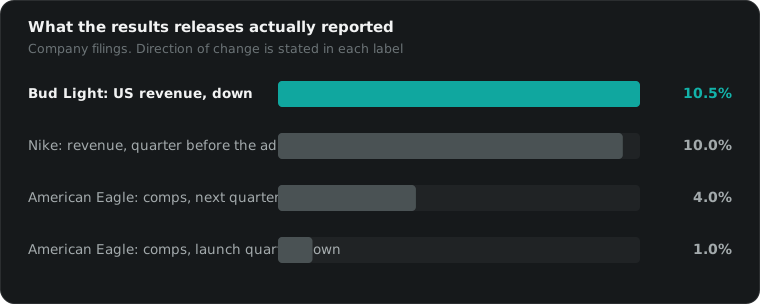
Controversial ads only pay when the people you offend were never going to buy. Nike's much cited 10 percent revenue growth came from the quarter that ended on 31 August 2018, two days before the Kaepernick ad ran. Bud Light's US revenue fell 10.5 percent after its April 2023 backlash.
Controversial ads are the most misread case studies in advertising. Everyone quotes the same two campaigns, usually with the wrong numbers attached, and draws a lesson that does not survive contact with a profit and loss statement.
The honest version is narrower and less fun. Controversy works when the people you upset were never customers. It ruins you when they were. Everything else in this post is detail on how to tell those two situations apart before you spend the money.
What makes an ad controversial rather than just bad?
A bad ad is ignored. A controversial ad takes a position that a definable group actively rejects, and forces everyone watching to pick a side. Tastelessness is not controversy. A pun an agency thought was daring is not controversy. It only counts when part of the audience chooses against you and says so publicly.
That definition rules out most of what gets called controversy in a creative review. The test is not whether anyone in the room winced. It is whether anyone outside it changed what they buy.
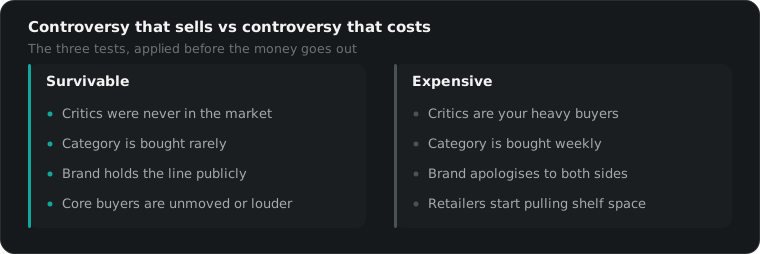
Three things decide which way controversial ads go.
- Who is offended. Existing heavy buyers, or people who were never in the market.
- How often the category is bought. A weekly purchase can be switched permanently. A car cannot.
- Whether the brand holds the line. Retreating tells the critics they were right and the supporters they backed nothing.
Do controversial ads actually increase sales?
Controversial ads increase sales only when the offended group was never going to buy anyway. When the offended group is the existing customer base, revenue falls instead. Anheuser-Busch InBev reported United States revenue down 10.5 percent in the quarter after the April 2023 Bud Light backlash. That is the cleanest evidence anyone has.
The Dylan Mulvaney partnership went live in early April 2023. Anheuser-Busch InBev’s second quarter 2023 results, published on 2 August 2023, reported United States revenue down 10.5 percent, sales to wholesalers down 15.0 percent and sales to retailers down 14.0 percent, attributed primarily to the volume decline of Bud Light.
The lesson sits in one paragraph. The offended group were the heavy buyers. Beer is bought weekly. The brand then satisfied nobody by apologising in a way that read as an apology to both sides. Three of the three conditions went the wrong way.
Compare that to a brand whose critics were never going to buy. The maths inverts completely, and the same tactic that cost Anheuser-Busch a quarter becomes free reach.
The Nike number everyone quotes is from the wrong quarter
The 10 percent revenue growth figure attached to Nike’s Kaepernick campaign comes from the fiscal 2019 first quarter, which ended on 31 August 2018. The campaign was revealed on 3 September 2018. The quarter had already closed two days before anyone saw the ad, so the growth it reports happened first.
The source is public. Nike’s fiscal 2019 first quarter results were reported on 25 September 2018 and cover the three months to 31 August. This is worth being pedantic about, because the figure gets repeated in every deck.
Nike’s own release credits the growth to its Consumer Direct Offense, not to a campaign that had not launched yet.
Nike kept growing after that, and the campaign was almost certainly a commercial success. But if your argument for running controversial ads rests on that specific number, your argument is measuring a period in which the ad did not exist. That should bother you more than it seems to bother the people presenting it.
What happened when a brand refused to apologise?
American Eagle refused to pull the Sydney Sweeney campaign after it drew criticism in late July 2025. The quarter containing the launch, ended 2 August 2025, showed comparable sales down 1 percent on revenue of $1.28 billion. The following quarter, ended 1 November 2025, showed comparable sales up 4 percent.
The detail is more interesting than the headlines. Revenue in that second quarter was $1.36 billion, and the chief executive credited recent campaigns with an uptick in awareness and engagement. The company kept the work running and reran the talent.
Read that carefully before you copy it. The launch quarter was still negative. The recovery quarter does not name the campaign at all in the results release. What you can defend is that the brand refused to retreat and its numbers improved over the following quarter. What you cannot defend is a causal claim, and anyone selling you one is selling you a story.
| Campaign | Date | Brand response | Reported outcome |
|---|---|---|---|
| Pepsi, Kendall Jenner | April 2017 | Pulled within about a day, apologised | No public sales impact claimed |
| Nike, Kaepernick | September 2018 | Held the line | Growth continued, but the quoted 10 percent predates the ad |
| Bud Light, Mulvaney | April 2023 | Apologised, satisfied neither side | US revenue down 10.5 percent the next quarter |
| American Eagle, Sweeney | July 2025 | Held the line, reran the talent | Comps down 1 percent, then up 4 percent |
What do you do in the ad account during a brand backlash?
Pause the specific asset being quoted, not the whole account. Turn comments off on the affected placements only. Split your retargeting audiences by date so the contaminated pool stays separate. Then watch branded search volume against branded conversion rate. Nobody writes this part down, and it is the part we get called about.
The first instinct is to pause everything. That is usually wrong. Pausing a campaign mid flight throws away the learning phase, and when you restart a week later you pay the acquisition cost twice. Keep the rest of the account running and accept that your reported cost per result will look strange for a fortnight.
Comments come second, and only on the affected placements, never account wide. Comment brigading on controversial ads distorts the engagement signal the platform optimises against, and the algorithm cheerfully finds you more people who want to argue. Those people cost the same per thousand impressions as buyers and convert at nothing.
Third, split your retargeting audiences by date. Everyone who entered your funnel during the story is a contaminated pool: high intent to look, low intent to buy. Mixing them into your normal remarketing audience poisons the return for a month.
Fourth, look at branded search. It is the fastest honest read you have. If branded search volume rises and branded conversion rate holds, the noise is reach. If volume rises and conversion rate falls, the noise is damage, and no amount of creative will fix it this quarter.
None of this is strategy. It is plumbing. But the brands that survive controversial ads are usually the ones whose media buyer knew which taps to close, and the brands that do not are the ones who paused everything on a Friday and rebuilt from zero on a Monday.
Should you run controversial ads on purpose?
Almost certainly not, and the reason is arithmetic rather than ethics. The upside of a successful controversy is a few weeks of earned reach. The downside is losing a customer segment permanently in a category people buy every week. Those two are not the same size, and only one of them is reversible.
A brand doing $5 million a month can absorb a bad quarter while the story burns out. A brand doing $50,000 a month cannot, and no agency will refund you for it.
There is also a quieter cost of controversial ads that never appears in the case studies. Ad accounts do not enjoy a boycott. Comment sections fill with brigading, engagement rates distort, the algorithm reads the wrong signal, and audience quality degrades for weeks after the story ends. We have cleaned up accounts where the creative was fine and the learning phase never recovered.
If you want attention on a modest budget, be specific rather than provocative. Say the number nobody else publishes. Name the thing your category avoids saying. That is closer to persuasive advertising than to shock, and it does not end in an apology.
What we tell clients
We do not recommend controversial ads, and we say so before anyone asks. Not because we are squeamish, but because the expected value is negative for almost every brand that raises it, and because we would be the ones running the account through the aftermath.
If you are genuinely trying to buy attention cheaply, ambush marketing is a smarter risk with a clearer exit, and there are far duller options that work better than either. Our pricing is published in full, including what the percentage costs in real money, and 15 minutes is usually enough to work out whether the idea on your desk is brave or just expensive. If you want to see how UK regulators actually draw the line, the ASA publishes every ruling it makes, weekly, in full.
Questions people actually ask
Do controversial ads increase sales?
Sometimes, and only under one condition: the people you offend were never going to buy from you anyway. When the offended group is your existing customer base, the ad destroys revenue. Anheuser-Busch reported US revenue down 10.5 percent in the quarter following the Bud Light backlash in 2023. The same mechanic that grows one brand shrinks another.
Did Nike's sales really go up after the Kaepernick ad?
The 10 percent revenue growth figure everyone quotes came from Nike's fiscal 2019 first quarter, which ended on 31 August 2018. The ad was revealed on 3 September 2018. The quarter had already closed. Nike did keep growing afterwards, but the number most often used as proof that the ad worked measures a period before the ad existed.
What made the Pepsi Kendall Jenner ad fail so fast?
It borrowed the imagery of protest without taking any position, so it had nothing to defend and nobody to defend it. Pepsi pulled it within about a day of release in April 2017 and said it had missed the mark. Controversy with no conviction behind it collapses immediately, because the brand itself agrees with the critics.
Should a small brand ever run a controversial ad?
Almost never on purpose. A large brand can absorb a quarter of lost revenue while the story burns out. A brand doing $50,000 a month cannot, and the downside is not symmetrical with the upside. If you want attention on a small budget, be specific and unusual rather than provocative. Specific is cheaper and it does not end in an apology.
Who decides whether an ad is too offensive to run?
In the UK, the Advertising Standards Authority rules on complaints and publishes its decisions every Wednesday, and an upheld ruling means the ad has to be withdrawn or amended. In the US there is no equivalent body for taste, so the platforms and the retailers do it instead. Either way the decision arrives after you have spent the production budget.
How long does an advertising backlash usually last?
The online phase is short, often under two weeks. The commercial phase is not. Bud Light lost shelf space and habit, and volumes were still depressed a year later. The useful question is not how long people will be angry. It is whether the anger changes a purchase that happens weekly, because weekly purchases turn a news cycle into a permanent switch.