Types of advertisements and what each costs

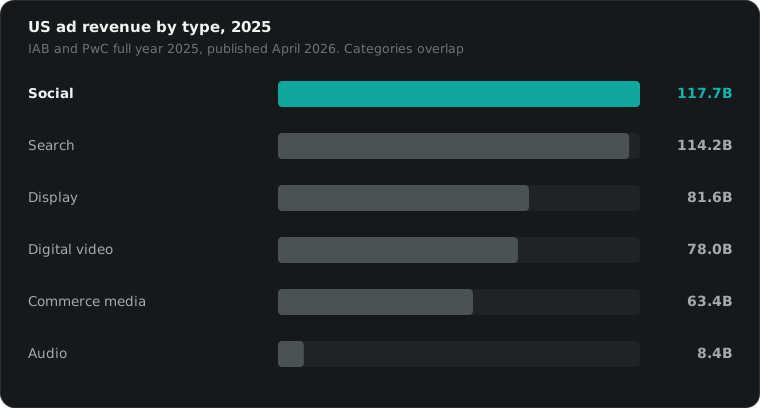
The main types of advertisements are search, social, display, video, commerce media and audio. In 2025 US digital ad revenue hit 294.6 billion dollars, and social passed search for the first time at 117.7 billion against 114.2 billion, according to the IAB and PwC.
Types of advertisements get listed the same way in every article: a flat set of twenty formats, no numbers, no idea which ones anyone actually buys. That list is useless if you are the one deciding where next month’s budget goes.
This is the version organised by money. Where the spend actually is, what each format does that the others cannot, and what it takes to run each one properly. The figures come from the IAB and PwC’s full year 2025 report, published on 16 April 2026.
What are the main types of advertisements?
Six categories cover nearly all paid advertising: social, search, display, digital video, commerce media and audio. In the United States in 2025 they were worth $117.7 billion, $114.2 billion, $81.6 billion, $78.0 billion, $63.4 billion and $8.4 billion. They overlap on purpose, because a video ad in a social feed counts twice.
| Type | US revenue, 2025 | Growth | What it is genuinely good at |
|---|---|---|---|
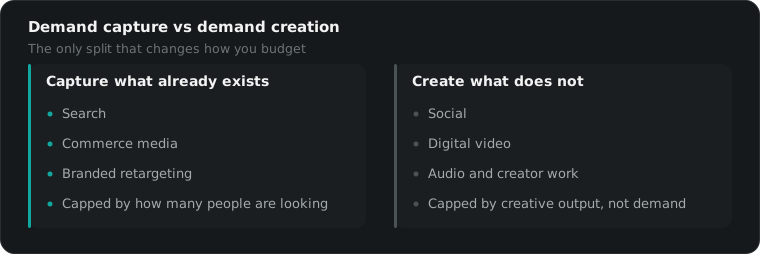
| Social | $117.7B | 32.6% | Creating demand that did not exist this morning |
| Search | $114.2B | 11.0% | Catching demand that already decided |
| Display | $81.6B | 9.8% | Cheap reach and retargeting, rarely first touch |
| Digital video | $78.0B | 25.4% | Explaining something a static cannot |
| Commerce media | $63.4B | 18.0% | Buyers already inside a shopping session |
| Audio | $8.4B | 10.2% | Long commutes and low competition |
Read the shares, not just the totals. They add to more than 100 percent because a single ad can sit in several categories. That double counting is the point: the format boundaries stopped being clean around 2020 and nobody has redrawn them since.
Which types of advertisements are actually growing?
Social passed search in 2025 for the first time, at $117.7 billion against $114.2 billion, growing 32.6 percent while search grew 11.0 percent. Digital video grew 25.4 percent to $78.0 billion and commerce media grew 18.0 percent to $63.4 billion. Display and audio each grew under 11 percent.
The IAB and PwC report puts US digital advertising at $294.6 billion for 2025, up 13.9 percent. It is the source for every figure on this page, and it is free to read.
Search did not shrink. It matured. There is a ceiling on how many people type a buying query in a given month, and once you own those queries you cannot buy more of them at any price. Social has no such ceiling, which is why the money went there.
The other number worth holding is video at $78.0 billion, up 25.4 percent. That is not a channel, it is a format that has colonised every channel. Video inside social, video on connected televisions, video in search results. If your brand cannot produce video at a reasonable cost per asset, half the growth in advertising is closed to you.
What do the main advertising formats cost to run?
Not the media cost. The cost of running each format competently, which is the number that catches people out. Search is the cheapest to operate and the hardest to scale. Social is cheap media and expensive creative. Video is almost entirely production. Display is nearly free to run and usually oversold.
- Search. Cheapest to operate. A tight account with good negatives can be maintained in a few hours a week. Creative demands are low. The constraint is demand volume, not skill.
- Social. Cheap media, expensive creative. Assume you will burn three to six new concepts a month once spend is meaningful, because fatigue arrives faster here than anywhere else.
- Commerce media. Operationally fiddly, high intent, and dependent on your product feed being clean. A broken feed will quietly cap your spend and nobody will tell you.
- Video. Production is the whole cost. Distribution is cheap by comparison, which is the opposite of what most people assume.
- Display. Almost free to run and almost always oversold. Useful for retargeting, dangerous as a first touch.
- Audio. Low competition and easy to underestimate. Scripts matter more than targeting.
The pattern is consistent. The types of advertisements with the cheapest media have the most expensive creative, and the ones with expensive media need almost no creative at all. Budgets that only count media spend get this wrong every time.
Which type should you start with?
Start with one, run it properly for a full quarter, then add a second. Splitting $4,000 a month across four platforms is the most common mistake we see, and it fails for a mechanical reason rather than a strategic one. Every platform needs a volume of conversions before its optimisation does anything useful.
A quarter of a small budget never gets there. You end up paying four platforms to stay permanently in learning, and none of them ever sees enough data to earn its place in the mix.
The order that usually works: start where your buyer already is, run it for a full quarter, then add the channel that fills the gap the first one leaves. If you started on search because demand exists, add social to make more of it. If you started on social because nobody is searching for what you sell, add search to catch the demand you created.
Google’s own documentation on campaign types is a better guide to what each format is for than most agency blogs, and it is free. Read it before you let anyone sell you a channel mix.
What about the offline types of advertisements?
Offline types of advertisements are still real and still useful. Television, radio, print and out of home reach a defined geography at scale without asking permission, which is the one thing digital struggles with. What they cannot do is tell you who converted, which makes them much harder to justify honestly.
In the Gulf that trade matters more than the global averages suggest. Commutes are long, radio still has genuine reach, and out of home along the main arteries of Riyadh or Dubai buys a kind of visibility no feed placement replicates.
Anyone selling you attribution on a billboard is selling you a model, not a measurement. Buy offline for reach you can describe and defend, and hold it to a brand search lift, not a return on ad spend figure to two decimal places.
Which types of advertisements do these lists always miss?
Two types of advertisements get left off almost every list, and both are already large. Creator advertising reached $37 billion in the United States in 2025, more than four times the entire audio category. The second is messaging, which has no row in anybody’s taxonomy and carries a serious share of the buying conversation in the Gulf.
Take creator advertising first. Most format lists still file it under social, or worse, under public relations. It is neither. It is a media buy with a production dependency attached, and it prices like one. The creator sets the rate, the platform takes the distribution, and your control over the creative sits somewhere between low and none.
It matters because it fails differently from everything else on this page. A bad search campaign wastes money quietly. A bad creator campaign puts your claim in someone else’s mouth, on their account, permanently, and disclosure rules apply to both of you.
Messaging is the other one. In the Gulf a serious proportion of the buying conversation happens in WhatsApp, and no channel taxonomy has a row for it. Click to message campaigns are technically social ads, but they behave like a different medium: no landing page, no checkout, a human replying. We have run accounts in Saudi and Jordan where click to message beat a conventional funnel outright, and the reporting looked broken until we stopped measuring it as ecommerce.
Neither of these appears in the standard list of types of advertisements, and both are where a chunk of the practical opportunity in MENA currently sits.
Where we would put the money
The honest answer changes with budget, which is why we publish ours. Under $5,000 a month, pick one of these types of advertisements and learn it yourself, because the agency fee on top of a small budget is the largest single cost in your account. We say that on calls and it costs us work.
Above that, the mix is a real decision and it is worth doing properly. If you want the mechanics of how that money gets spent day to day, we have written up media buying and what it actually involves, and persuasive advertising covers the creative side that decides whether any of these formats work at all.
Our pricing is published in full, including what the percentage costs in real money at every level of spend. If you want the shortcut, 15 minutes is usually enough to say which two types of advertisements are worth your next quarter and which four are not.
Questions people actually ask
What are the main types of advertisements?
Search, social, display, video, commerce media and audio cover almost all paid advertising today, with out of home, print, radio and television sitting alongside them offline. The IAB and PwC report that US digital advertising alone reached 294.6 billion dollars in 2025. The categories overlap, because a video ad inside a social feed counts in both.
Which type of advertising gives the best return?
Search usually returns the most per dollar because it catches people who have already decided to buy. That also caps it: you cannot buy more demand than exists. Social costs more per sale but creates demand rather than harvesting it. Most accounts that plateau have maxed out search and never built anything upstream of it.
Is social media advertising bigger than search now?
Yes, for the first time. The IAB and PwC report social media at 117.7 billion dollars in 2025 against search at 114.2 billion, with social growing 32.6 percent year on year while search grew 11.0 percent. The gap is driven by video inside social feeds and by creator advertising, which reached 37 billion dollars.
How many advertising formats should a small brand run?
One, properly, before adding a second. A brand spending under 5,000 dollars a month that splits across four platforms gives none of them enough data to optimise against, and the platforms need volume before their models do anything useful. Pick the channel your buyer is already on, spend there for a full quarter, then judge it.
What is commerce media and does it count as advertising?
Commerce media, often called retail media, is advertising sold by retailers on their own sites and apps, such as sponsored product listings on Amazon or Noon. It reached 63.4 billion dollars in the US in 2025. It behaves like search, because the buyer is already in a shopping session, and it is usually the highest intent inventory available.
Are offline advertising types still worth buying?
Yes, for specific jobs. Out of home is still the cheapest way to reach a defined city at scale, and radio still works in markets with long commutes, which describes most of the Gulf. What offline cannot do is tell you who converted. Buy it for reach you can name, not for a return you plan to measure precisely.