Niche marketing when the audience is tiny

Niche marketing fails on ad platforms for two mechanical reasons. Google marks low volume keywords inactive, and a 25,000 person audience saturates at roughly 600 dollars a week at an 8 dollar CPM. The fix is broad targeting with creative that disqualifies, plus search for the few who type the term.
Niche marketing reads beautifully in a strategy deck and behaves badly in an ad account. The commercial logic is sound. Narrow audiences convert harder, argue less about price, and tell their friends. The problem is mechanical, and it shows up on day three of the campaign.
The thing that defines your niche is almost never something the platforms will sell you. So the plan and the platform disagree, and the platform wins.
What is niche marketing, and what does it cost to run?
Niche marketing means aiming a product at a narrowly defined group instead of a broad market. Commercially it usually works, because narrow buyers convert harder and argue less about price. Operationally it costs you in three places: higher CPMs, faster frequency build up, and less conversion data for the platform to learn from.
You pay in CPM, because a thin auction has fewer bidders and less inventory, and prices reflect scarcity. You pay in frequency, because there are only so many people and the platform will show your ad to the same ones again. And you pay in learning, because optimisation models need conversion events and a small audience produces few of them.
None of that makes niche marketing wrong. It means the margin per customer has to carry it, and most people never check whether it does.
Why do ad platforms punish niche audience targeting?
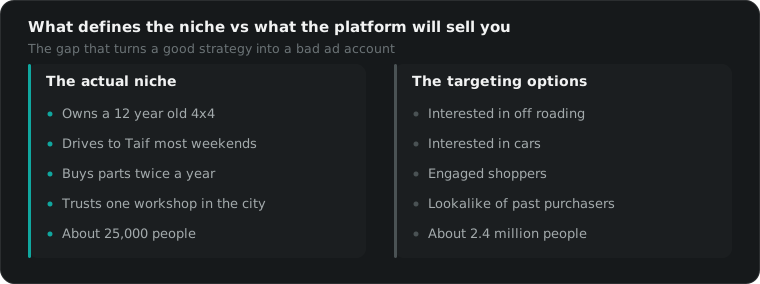
Ad platforms are built on volume, and their safety mechanisms trigger below it. Google marks keywords with almost no search history as low search volume and stops serving them. Meta keeps removing detailed targeting options, so the interest stack you build is a rough proxy, not your actual niche.
On Google the punishment is explicit. A keyword with very little search history gets a low search volume status, assessed on worldwide searches over the past twelve months, and it stays inactive until volume rises. Google rechecks about once a week. There is also a paused, low activity status for keywords with no impressions in thirteen months. Your perfectly targeted phrase does not underperform. It simply never runs.
On Meta the punishment is quieter. Detailed targeting options have been removed steadily year after year, and the ones left are broad proxies. You can target people interested in off roading. You cannot target people who own a 2016 Land Cruiser and drive to Taif most weekends, which is the actual niche you were describing on the call.
There is a regional version of this too. In Saudi and the UAE the interest lists are thinner than in the US, and Arabic language signals are patchy, so the same interest stack that returns 400,000 people in Chicago returns 30,000 in Jeddah. I have seen accounts where the whole targeting plan collapsed the moment we checked audience size on the ground rather than in the deck.
So you build a stack of interest layers that approximates the niche, get an audience of 40,000, and congratulate yourself on precision you do not have.
How fast does a small audience burn out?
Faster than anyone plans for. A 25,000 person audience absorbs about 75,000 impressions before average frequency hits three. At an 8 dollar CPM that is roughly 600 dollars, so a week of normal spend exhausts it. The arithmetic is simple enough to check against your own numbers in a minute.
| Audience size | Impressions at frequency 3 | Weekly spend that saturates it, at an $8 CPM | What that buys you |
|---|---|---|---|
| 25,000 | 75,000 | $600 | About one week of runway |
| 100,000 | 300,000 | $2,400 | Roughly a month |
| 250,000 | 750,000 | $6,000 | A quarter, if creative rotates |
| 1,000,000 | 3,000,000 | $24,000 | Enough room to actually optimise |
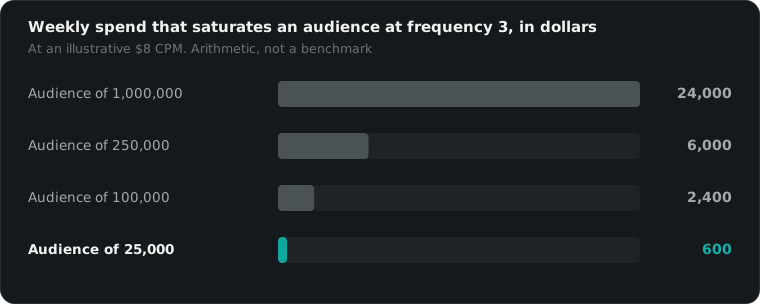
The $8 CPM is illustrative and runs lower across much of MENA, higher in the Gulf and much higher in the US. The shape holds everywhere. At 25,000 people you have about a week before the same faces are seeing the same ad for the fourth time, and the account tells you in a specific way: cost per result creeps up while click through rate falls, and nothing you change in the campaign settings helps.
That pattern is not fatigue in the audience. It is exhaustion of the audience.
The optimisation breaks at the same time. Meta wants roughly fifty conversions per ad set per week before its model has anything to work with. A niche marketing campaign aimed at 25,000 people rarely gets near that, so the algorithm is guessing with your money, and you are paying thin auction prices for the privilege.
Should you target the niche or let the creative do it?
Let the creative do it. On paid social, run a broad audience and put the qualifier in the first three seconds of the ad. The wrong people scroll past and cost you almost nothing. On search, do the opposite, because the query already carries the intent and narrow is correct.
The qualifier has to be concrete. Not “for adventurous people” but “if your Land Cruiser has done more than 200,000 kilometres”. The right people stop, which is what you wanted from targeting in the first place. And the platform gets a large pool to optimise inside, so its model actually works. This is the single biggest change in how I have run accounts over the last five years.
Search is the exception. Volume is the constraint there, not precision. Accept that a genuinely niche search campaign might deliver forty clicks a month at a high cost per click. Forty clicks from people who typed the exact thing can be worth more than a million impressions.
When does niche marketing actually pay?
Niche marketing pays when three conditions hold. Gross margin per customer is high enough to absorb an expensive CPM. The audience is already assembled by somebody else, in a newsletter or a community you can buy into. And the purchase is considered, so a high conversion rate carries the volume you never get.
- Gross margin per customer is high. A $30 product cannot absorb a $40 CPM audience. A $3,000 service can absorb almost anything.
- The niche is reachable through someone else. A newsletter, a forum, a WhatsApp group, a creator who already serves exactly that group. Buying access to an assembled audience beats trying to reassemble it from interest checkboxes. This is where micro influencers genuinely outperform, and one of the few places I would spend before paid social.
- The purchase is considered. Niche audiences are small, so you cannot win on volume. You win on conversion rate, and conversion rates only get high when the buyer has been looking.
Miss the first condition and no channel saves you. Miss the second and your costs are structurally higher than a broader competitor’s. Miss the third and you are paying premium CPMs for impulse buys that were never going to happen.
What we run instead of pure niche targeting
Niche marketing works best as three things running together. A narrow search campaign that accepts low volume. Broad paid social with creative that disqualifies loudly. And one or two partnerships with people who already own the audience. That combination beats interest stacking in almost every niche account I have taken over.
If you want the wider map, types of advertisements covers what each channel is genuinely good at, and how to write a digital marketing plan is where you work out whether your margin per customer can carry a niche at all.
The uncomfortable part first, as usual. If your niche is 25,000 people and your product sells for $30, niche marketing is not a media problem and no agency will fix it. Change the price or widen the product. If the margin is there, our pricing is published in full so you can model the fee before anyone calls you, and 15 minutes is usually enough to tell whether your niche is small enough to be an advantage or small enough to be a wall.
Questions people actually ask
What is niche marketing?
Niche marketing is aiming a product at a narrowly defined group rather than a broad market. Commercially it works well, because narrow audiences convert harder and tolerate higher prices. Operationally it is awkward, because the ad platforms sell interests and behaviours, not the specific attribute that actually defines your niche.
Why do my niche keywords stop showing in Google Ads?
Google assigns a low search volume status to keywords with very little search history, measured across worldwide searches over the past twelve months. Those keywords stay inactive until volume rises, and Google rechecks them about once a week. It is not a quality problem with your account. There simply are not enough searches.
How small is too small for a Meta audience?
There is no hard floor, but below roughly 50,000 people the practical problems start. Frequency climbs within days, CPMs rise because the auction is thin, and there is not enough conversion volume for the optimisation model to learn anything. At 25,000 people you saturate the audience in about a week at typical rates.
Is broad targeting better than niche targeting now?
In most accounts I run, yes, on Meta. Broad targeting with creative that names the buyer in the first three seconds usually beats a stack of interest layers. The creative does the qualifying that the targeting used to. On search it is the opposite, because the query already tells you the intent.
Does niche marketing cost more per customer?
Per thousand impressions, almost always yes, because a thin auction has fewer bidders and less inventory. Per customer, often no, because conversion rates are higher and price sensitivity is lower. The trade only works if gross margin per customer is high enough to absorb the CPM. Low priced niche products rarely clear it.
What is the best channel for a genuinely small audience?
Search first, because intent is explicit even at low volume, and forty expensive clicks a month can be worth more than a million impressions. Then buy access to audiences somebody else already assembled: newsletters, communities and creators who serve exactly that group. Broad paid social comes third, not first.