Ambush marketing, and the law that stops it

Ambush marketing is advertising around an event you have not paid to sponsor. It is usually legal. Bavaria put 36 women in orange dresses at a 2010 World Cup match, FIFA ejected them, and the brand got global coverage for the price of 36 dresses and two arrests.
Ambush marketing is advertising built around an event you have not paid to sponsor. It is one of the few areas of the job where a small budget can beat a large one, and one of the few where a lawyer can undo your whole quarter.
The category gets taught badly. Most write ups list the same three stunts and skip the part that decides whether you can do it: what is actually protected, by whom, and for how long. That part is public, and it is worth twenty minutes of your time before anyone books a billboard.
What is ambush marketing?
Ambush marketing is any attempt to create a commercial association with an event without buying the rights to it. FIFA’s own brand protection guidance says it takes advantage of the interest in an event and devalues official sponsorship, which is why rights holders treat it as a priority threat rather than a nuisance.
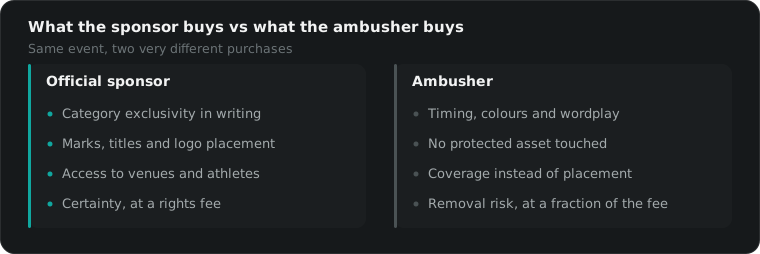
Two flavours, and they carry very different risk.
- Direct. Using protected words, marks or imagery, or implying you are an official partner. This is the version that gets you a letter.
- Indirect. Timing, colours, athletes, geography, wordplay. No protected asset touched. This is where nearly all the good work lives.
The line between them is drawn by whoever owns the event, and it is drawn wider than most marketers assume.
Is ambush marketing legal?
Ambush marketing is usually legal. Ordinary trademark law only stops you using someone’s marks, and timing an ad to a tournament, using its colours or signing an athlete breaks none of them. The exceptions are specific rather than general: protected marks, official titles, and the bespoke laws host countries pass for a single event.
Event organisers know trademark law alone is not enough, which is why that bespoke legislation exists. The United Kingdom’s London Olympic Games and Paralympic Games Act 2006 is the clearest published example. Section 19 let the Secretary of State make regulations controlling advertising in the vicinity of venues, for a limited period, overriding permissions the advertiser had already obtained from the landowner or local authority.
Read that again, because it is the important bit. A brand could hold a valid contract for a billboard site and still be told to take the poster down, because the event law outranked the contract. That is the exposure. Not a lawsuit, a removal, mid flight, with the money already spent.
Similar association rights have followed for later events. The practical rule for a media buyer is simple. Check what statute exists in the host country, check its dates, and assume the protected window starts earlier and ends later than you would guess.
Which ambush marketing examples actually worked?
Four ambush marketing examples are worth studying: Bavaria at the 2010 World Cup, Kulula Air the same summer, Paddy Power at the 2012 London Olympics, and BrewDog at Qatar 2022. Three of them worked. The table sets out what each brand did, what the rights holder did back, and what it cost them.
| Brand | Event | Date | What they did | What happened |
|---|---|---|---|---|
| Bavaria | FIFA World Cup | June 2010 | 36 women in orange dresses at Netherlands v Denmark | Ejected, two arrested, charges later dropped, global coverage |
| Kulula Air | FIFA World Cup | 2010 | Called itself the unofficial national carrier of the you know what | Ad withdrawn after FIFA objection, then reran the joke about the withdrawal |
| Paddy Power | London Olympics | July 2012 | Poster claiming official sponsorship of the largest athletics event in London this year, meaning a village in France | Organisers asked for removal, then dropped it on 24 July 2012 |
| BrewDog | FIFA World Cup | November 2022 | Declared itself proud anti sponsor of the tournament | Heavy coverage, then criticism for still showing the matches in its bars |
Bavaria is the one people remember, but Paddy Power is the one to copy. The joke was legally engineered. There is a village called London in Burgundy, and the bookmaker had genuinely sponsored an event there. The claim on the poster was true, which meant any attempt to remove it turned into a story about a governing body bullying a brand over a true statement. Organisers instructed the media owner to take the posters down, then backed off within days. The campaign ran on.
BrewDog is the one to learn from in the other direction. Positioning yourself as the anti sponsor only works if your own behaviour survives the follow up question. It did not, and the coverage turned inside a week.
What does an ambush actually cost?
An ambush costs less than the sponsorship rights and more than you budgeted, and most of the money goes somewhere that is not media. It goes on creative good enough to be worth retelling, and on legal review of the wording, the imagery, the venue proximity rules and the dates before anything runs.
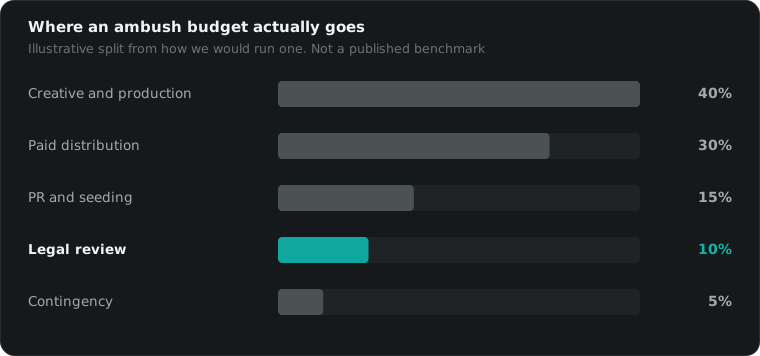
An ambush marketing campaign is a public relations play with a media budget bolted on. The paid distribution is often the smallest line. What you are really buying is a story that journalists want to retell for free, and the production quality that makes it worth retelling.
The line nobody budgets for is legal. Not litigation, review. That review has to happen early enough that the idea can still change, which means before the shoot, not after it. A stunt killed the week before the event has cost you everything and returned nothing.
What did the 2026 World Cup change?
The 2026 World Cup made the geography of the problem much harder, and almost nobody planned for it. The tournament ran from 11 June to 19 July across 16 cities in three countries, with 48 teams and 104 matches instead of 64. Three legal systems, 16 sets of venue rules, one summer.
The host split was 11 cities in the United States, three in Mexico and two in Canada. That meant three sets of local advertising ordinances running at the same time as the tournament rules. A campaign cleared in one host city was not automatically clear in the next.
The length matters as much as the spread. A five and a half week window with more than a hundred matches means the protected period covers most of a quarter, not a fortnight. If your media plan had a summer flight in it, the flight sat inside the window whether you intended it to or not.
FIFA’s stated approach is education first, with formal action reserved for serious infringements that carry clear commercial intent. In practice that means the phone call comes before the lawsuit, and the phone call usually goes to the media owner rather than to you. Which is why the removal risk, not the litigation risk, is the one to plan for.
The lesson for the next cycle is boring and useful. Multi country events push ambush marketing further away from the stadium and further toward the second screen, where nobody owns the rights and the audience is sitting anyway.
When should you not do it?
Do not run an ambush when you cannot afford to lose the asset, when the joke needs explaining, or when the idea has to survive four committees before it goes live. Anything approved that slowly arrives late, defanged, and looking exactly like the association grab the rules were written to stop.
Ambush marketing punishes hesitation. Half of these campaigns work because the brand accepted that the poster might come down and planned the second act around it. If your board needs certainty, buy the sponsorship or buy nothing.
The other honest answer is that most brands should skip it entirely. If you are spending under about $25,000 a month, the money goes further running to the audience rather than at the event: search terms around the fixture, the second screen during it, the delivery window at kick off. That is unglamorous and it works. We say this on calls and lose the work sometimes.
What we would do instead
Most of the value people chase with ambush marketing is available without the risk, through timing and buying discipline rather than stunts. That is closer to media buying than it is to public relations, and it is what actually fills the pipeline.
If you want the neighbouring reading, we have looked at controversial ads and what happened to the brands afterwards, and at persuasive advertising and which techniques survive a real media buy.
Our pricing is published, including what the percentage works out to in real money, so you can check the numbers before anyone gets on a call. If you would rather just ask whether a moment is worth chasing, 15 minutes is usually enough to settle it.
Questions people actually ask
Is ambush marketing illegal?
Usually not. Running an ad campaign timed to a tournament, using its colours, or signing an athlete is generally lawful. What is unlawful is using protected marks, official titles, or trading on a registered association right. Host countries also pass event specific laws that create offences which would not exist the rest of the year, so the answer changes by country and by event.
What is the difference between ambush marketing and sponsorship?
A sponsor pays a rights holder for permission to associate with an event and gets exclusivity in its category. An ambusher pays nobody and builds an association through timing, athletes, location or wording. The sponsor buys certainty and logo placement. The ambusher buys attention and legal risk, usually at a small fraction of the rights fee.
What happened to Bavaria at the 2010 World Cup?
On 14 June 2010, during the Netherlands versus Denmark match in Johannesburg, 36 women wearing orange dresses linked to a Bavaria promotion were ejected from the stadium and two were arrested. FIFA filed a complaint with South African police. The charges were later dropped, and the stunt generated worldwide coverage for a brewery that had bought no rights at all.
Can an athlete promote a non sponsor during the Olympics?
Only within limits. The IOC restricts how competitors, coaches and officials can appear in advertising during the Games period, and national committees run registration systems for generic athlete advertising. The restrictions have loosened since 2019 but the calendar still matters. Anything not cleared before the blackout window opens is a problem for the athlete, not just the brand.
Does ambush marketing actually work?
It works when it is funny, fast and clearly not pretending to be official. It fails when it looks like a brand trying to steal a badge it could not afford. The cheap ones travel because journalists enjoy writing about them. Budget for the media pickup, not the media buy, because the media buy is rarely where the value is.
What should a smaller brand do instead of ambushing?
Run to the audience, not the event. Buy the moments around the fixture: the pre match search terms, the second screen, the delivery window at kick off. It is cheaper than a stunt, it carries no legal exposure, and on a modest budget it usually returns more. Ambush marketing is a public relations play with a media budget bolted on.