Audience targeting in 2026: what still works

Audience targeting is now a signal you give the platform, not a filter it obeys. Google treats Performance Max audience signals as guidance, not targeting. The inputs that still change delivery are ones you own: customer lists, site events and exclusions. A Customer Match list needs 100 members to stay live.
Audience targeting used to mean drawing a box around a group of people and telling the platform to stay inside it. That is not what the button does any more, on either Google or Meta, and most of the arguments about it are arguments about a product that no longer exists.
What replaced it is a system where you supply evidence and the platform decides. Some of your inputs are binding. Most are advisory. Knowing which is which is the whole skill.
What does audience targeting actually control now?
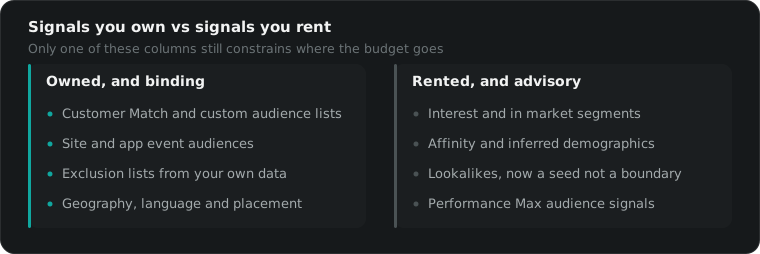
Audience targeting now splits into three tiers, and only the first behaves the way the interface implies. Hard constraints like geography, language, age and placement are obeyed. Soft signals like interests, demographics and lookalikes only bias delivery. Lists you own, Customer Match and custom audiences, carry real weight because they contain identifiers rather than inferences.
Hard constraints. Geography, language, age minimums, device and placement. These are obeyed. So are exclusion lists built from your own data.
Soft signals. Interests, in market segments, affinity, demographics, and lookalikes. These bias delivery. They do not fence it. Google is explicit about this in its own documentation on audience signals in Performance Max, which describes them as guidance for the system rather than a targeting restriction, and warns it can take up to two weeks for the model to absorb a new one.
Owned lists. Customer Match on Google, custom audiences on Meta. These are the ones with real weight, because they contain identifiers the platform can match to actual accounts rather than infer.
The mistake almost everyone makes is treating tier two as if it were tier one, then reporting on it as if the box held.
Which audience signals still change delivery?
Location, language, uploaded customer lists, site event audiences and exclusions from your own data still bind delivery. Interests, in market segments and lookalikes no longer do. Google removed similar segments in 2023. Meta folded detailed targeting into Advantage+ audience as a suggestion. The table below is the honest state of each control in 2026.
| Control | Google Ads | Meta Ads | Binding? |
|---|---|---|---|
| Location and language | Yes | Yes | Yes |
| Age and gender | Yes | Yes, limited by category | Mostly |
| Interest and in market segments | Signal only in PMax and Demand Gen | Suggestion inside Advantage+ audience | No |
| Lookalike or similar | Similar segments removed in 2023 | Used as a seed, not a boundary | No |
| Customer list | Customer Match, 100 member floor | Custom audience from list | Yes |
| Site or app event audience | Yes | Yes | Yes |
| Exclusions from your own list | Yes | Yes | Yes |
| Detailed interest exclusions | Limited | Removed in 2024 | Gone |
Two rows deserve attention. The similar audiences Google removed were never replaced with anything you control, only with optimised targeting that expands on its own. And Meta removed detailed targeting exclusions in 2024, which means the only reliable way to keep existing customers out of a prospecting campaign is to upload them and exclude the list.
If your account still has a prospecting campaign excluding an interest, it has not been rebuilt since 2024.
How do you build custom audiences that actually work?
Four steps. Fix the data collection before you build the list, because a broken email capture cannot be segmented into working. Split by lifetime value rather than recency. Refresh on an automated monthly schedule, since Google expires Customer Match members after 540 days. And build the exclusion list before the targeting list.
- Fix the collection before the list. A customer list is a downstream product of advertisement tracking. If email capture is inconsistent, no amount of segmentation saves it.
- Segment by value, not by recency. Upload your top 20 percent by lifetime value as one list and everyone else as another. A lookalike seeded on your best customers behaves differently from one seeded on all buyers.
- Refresh on a schedule. Google expires Customer Match memberships after 540 days of no update, and its own guidance requires at least 100 members added or updated inside that window to stay eligible. Monthly uploads, automated, not a quarterly reminder someone forgets.
- Build the exclusion list first. Recent purchasers, current subscribers, job applicants, competitors who filled in a form. Excluding well is worth more than targeting well, and nobody does it.
Match rates are the number to watch, and both platforms show you one. If a list of 10,000 emails matches 3,000 users, the list is mostly stale, mostly work addresses, or hashed wrong on upload. Every lookalike built from it inherits that damage silently, and nothing downstream will tell you.
Why broad audience targeting usually beats narrow
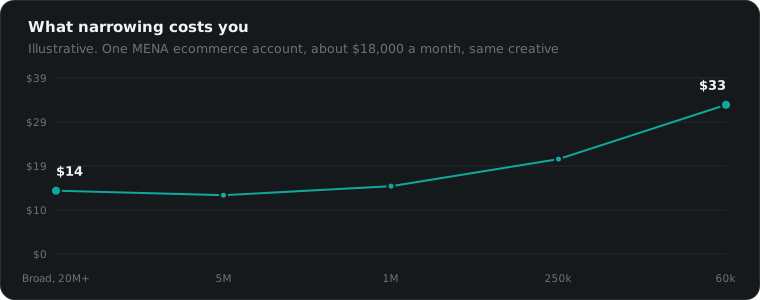
Narrowing feels like precision and behaves like a tax. Every constraint you add removes eligible impressions, which pushes your CPM up, which reduces the conversions the bid model sees, which slows learning, which makes results worse. Broad audience targeting with a hard exclusion list gives the model room and still keeps your existing customers out.
The pattern below is illustrative, from one MENA ecommerce account, but the shape repeats often enough that we now start broad by default and make people argue for narrowing.
The real targeting is the creative. An ad that opens with a shot of a specific product, in a specific language, addressed to a specific problem, filters the audience harder than any interest checkbox, and it does it without raising your CPM. That is why we spend more time on creative briefs than on segment lists, and why the contextual advertising approach often outperforms behavioural on cold traffic.
How do you keep control when the platform expands anyway?
You cannot stop the expansion. You can shape what it expands towards, and you can stop it wasting money on people you already own. Split prospecting and retargeting into separate campaigns. Exclude your customer list at campaign level. Optimise towards a purchase with a value attached. Then read the delivery reports and fix the creative.
Five things that still work, in rough order of how much they are worth.
- Separate campaigns, not separate ad sets. Budget moves between ad sets inside a campaign and follows the cheapest conversion, which is almost always retargeting. If you want to know what prospecting cost, prospecting needs its own campaign and its own budget.
- Exclude at campaign level, from a list. Recent purchasers, active subscribers, staff. Uploaded, refreshed, applied to every prospecting campaign. This is the single highest value setting left in either platform.
- Feed the model better conversions. Optimising towards a purchase with a value beats optimising towards an add to cart. A model given the right target expands towards the right people without being told who they are.
- Use audience signals as a starting point, then leave them alone. Changing a Performance Max signal weekly resets a model that needs about two weeks to absorb it. Set it once, judge it after a month.
- Read the placement and demographic reports, then act on the creative. If delivery skewed to 55 plus men and your buyers are 28 year old women, the fix is the creative and the landing page, not another checkbox.
None of that is glamorous. All of it survives the next interface change, which is more than can be said for most audience targeting advice written before 2024.
Does audience targeting work differently in MENA?
Yes, in three ways that catch imported playbooks. Arabic and English audiences in the GCC behave like separate markets, so language beats interest as a split. Device mix varies enormously, from roughly 50 percent iOS in Saudi Arabia to 11 percent in Egypt, which changes measurement quality. And Ramadan moves CPMs more than any targeting change.
Language is the strongest segment nobody uses properly. Arabic and English audiences in the GCC behave like separate markets, with different CPMs, different creative winners and different times of day. Splitting by language beats splitting by interest almost every time.
Device split matters more than it does in the West. On StatCounter’s July 2026 figures, iOS is about 50 percent of mobile browsing in Saudi Arabia, 22 percent in the UAE and 11 percent in Egypt. The same audience targeting setup produces very different measurement quality across those three countries, so compare them separately or you will draw the wrong conclusion about Saudi.
Seasonality is not a rounding error. Ramadan and the two Eids move CPMs, conversion rates and shopping hours by more than any audience change you can make, which is a media planning problem rather than a targeting one.
What we do about it
We treat audience targeting as evidence supplied to a model, not as a fence. Broad prospecting, hard exclusions from owned lists, value based customer lists refreshed monthly, and creative doing the segmenting. On most accounts that combination costs less per customer than any interest stack we have replaced, and it takes less time to maintain.
Our pricing is public, so you can work out what this costs on your spend before speaking to anyone, and there are real accounts and their numbers if you want proof before a conversation. If you would rather just ask whether your audience targeting is doing anything at all, 15 minutes usually answers it.
Questions people actually ask
Does audience targeting still work on Meta ads?
Partly. Detailed interest targeting is now treated as a suggestion inside Advantage+ audience, so delivery can go outside the segment you picked. Custom audiences from your own data, and exclusions, still constrain delivery reliably. Meta also removed detailed targeting exclusions in 2024, so the way you keep existing customers out of a prospecting campaign is a customer list, not an interest exclusion.
What is the difference between a custom audience and a lookalike audience?
A custom audience is a list of people you already have a relationship with: site visitors, app users, customer emails, video viewers. A lookalike is a modelled group the platform builds by finding people who resemble that list. The custom audience is only as good as your tracking. The lookalike is only as good as the custom audience it was seeded from.
How many people do I need for a customer list to work?
Google requires at least 100 members added or updated in the last 540 days for a Customer Match list to stay eligible, but that is an eligibility floor, not a useful size. For seeding a lookalike or a value based bid strategy, aim for at least 1,000 real customers, and prefer your best 20 percent by lifetime value over everyone who ever bought.
Should I target broad or narrow?
Broad, in almost every account under six figures of monthly spend. Narrow audience targeting raises CPMs, starves the learning phase of conversions, and hides the fact that your creative is doing the real targeting. Start broad with a strong exclusion list, then narrow only when you have evidence a specific segment behaves differently, not because it feels more precise.
Is interest targeting worth anything now?
As a delivery constraint, rarely. As a research tool and a creative brief, yes. Splitting a test by interest still tells you which angle a group responds to, even when the platform expands delivery beyond that group. Use it to learn what to say, then let broad targeting and the creative do the work of finding the people.