Google Analytics alternatives that earn the switch

A Google Analytics alternative is worth it when you need raw event data, longer retention or your own hosting. A standard GA4 property keeps event data for only 14 months. Matomo, Piwik PRO, Plausible and PostHog each solve one of those. None of them replace Google Ads bidding signal.
A Google Analytics alternative is easy to recommend and expensive to get wrong, because the thing people dislike about GA4 is rarely the thing that is costing them money.
I have moved three clients off GA4 and moved one of them back. The pattern is the same each time. The dashboards get cleaner, the numbers get calmer, and then someone asks why Google Ads is bidding worse than it was in March.
Why do people want a Google Analytics alternative?
Most people want a Google Analytics alternative for one of four reasons: a standard property only keeps event data for 14 months, reports get thresholded and sampled, the event model broke their old numbers, or their legal team is uncomfortable with where the data goes. Only two of those need a new tool.
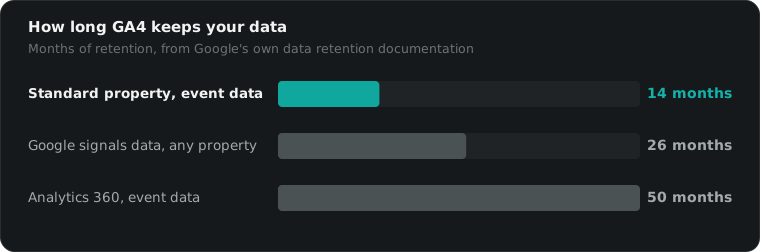
Retention is the concrete one. Google’s own data retention page sets the standard property maximum at 14 months for user level and event data. Analytics 360 goes to 50 months. Google signals data is capped at 26 months whatever you choose. So year on year analysis on a free property is not something you forgot to configure. It is not offered.
Thresholding is the annoying one. Turn on Google signals, look at a small segment, and rows disappear with a warning icon rather than a number. The data is there. Google will not show it to you.
The third reason is grief, and it is the one that sends people looking for a Google Analytics alternative fastest. Universal Analytics stopped processing hits on 1 July 2023, and a lot of teams never accepted the replacement. Sessions behave differently. Bounce rate came back as its own opposite. That is a real cost, but a new vendor does not refund it.
Which Google Analytics alternative fits which problem?
There is no single best Google Analytics alternative, only a right answer per problem. Matomo and Piwik PRO for ownership and hosting control. Plausible, Fathom or Umami for simple cookieless traffic numbers. Amplitude, Mixpanel or PostHog for product behaviour. Adobe Analytics for enterprises with the staff to run it.
| What you actually need | Where to look | Hosting | What it will not do |
|---|---|---|---|
| Raw event data, no vendor | BigQuery export from GA4 | Google Cloud | Nothing. This is not leaving GA4 |
| Own the data, keep the reports | Matomo, Piwik PRO | Yours or their cloud | Feed Google Ads bidding |
| Simple traffic numbers, fast | Plausible, Fathom, Umami | Theirs or a small VPS | Multi step funnels and value |
| Product behaviour and retention | Amplitude, Mixpanel, PostHog | Theirs, PostHog self hosts | Marketing channel reporting well |
| Enterprise reporting at scale | Adobe Analytics | Theirs | Cost under six figures |
The first row is the one most people skip. The BigQuery export from GA4 is included, it gives you every event at row level, and it removes sampling and thresholding from anything you query yourself. If your complaint is that GA4 hides data, that is the fix, and it does not involve changing tools.
The second row is where genuine switches happen. A bank in the Gulf that cannot send visitor data to a US cloud has a real constraint, and self hosted analytics is a real answer to it.
What do you actually lose when you leave GA4?
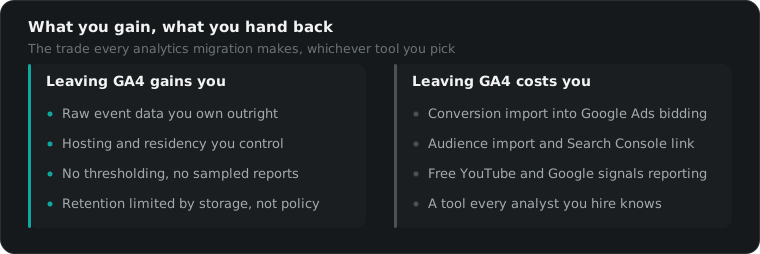
You lose the Google integrations, and on a paid media account that is the expensive part. No conversion import into Google Ads for Smart Bidding, no audience import, no Search Console link, and no free YouTube reporting. You also lose the tool every analyst you hire already knows how to use.
That last one sounds soft. It is not. On a Riyadh or Amman hire, GA4 is the only analytics product you can assume someone has touched. A Matomo instance with a custom schema means the person who built it is the only person who can maintain it, and they will leave.
The bidding loss is the measurable one. Smart Bidding learns from conversions it receives. Cut off the GA4 key event route and you need the Google Ads tag, enhanced conversions and ideally server side events doing the same job. That is fine, it is what we set up anyway, but it is work somebody has to do before you switch, not after.
Put simply, a Google Analytics alternative buys you ownership and charges you in integrations. Decide which one your account can afford to be short of.
There is one loss nobody warns you about. Every benchmark conversation you have with a client, an investor or a platform rep assumes Google Analytics numbers. Turning up with different definitions of session and channel means every meeting starts with twenty minutes of reconciliation.
Is privacy friendly analytics enough on its own?
For a content site, usually yes. For an ecommerce or lead generation account, no. Privacy friendly analytics tools are built to count visits without identifiers, which is exactly what makes them useless for attributing a purchase back to an ad click three days and two devices later.
The trade is honest and the vendors are honest about it. No cookie means no cross session stitching. You get clean traffic counts, referrer data and page performance, and you stop pretending you can follow a person around the internet.
If you buy media, you still need that path. What replaces it is not a dashboard, it is advertisement tracking done at the server: platform conversion APIs, hashed customer data, and a click ID stored on your own domain. That work is independent of which reporting tool you look at in the morning.
So run both. Lightweight analytics for the traffic picture, platform and server side data for the money. Anyone selling you one tool that does both is selling you a dashboard.
What changes in MENA and the Gulf?
Three things change. Data residency rules, including Saudi Arabia’s Personal Data Protection Law, push some clients toward hosting they control. Arabic and right to left dashboards are rare outside the big tools. And the local hiring market is trained on Google Analytics, so an unusual stack means you maintain it yourself.
Residency is the one that comes up in tenders. Government adjacent work in Saudi Arabia and the UAE increasingly asks where the data sits, and “a Google region somewhere” is not an answer that survives procurement. Self hosted Matomo on local infrastructure is.
The practical problems are smaller and more irritating. Card billing in USD is fine from the UAE and Saudi Arabia, harder from Lebanon. Arabic language support in the smaller tools is thin. Bot traffic from regional data centres inflates numbers in tools without decent filtering, and GA4’s filtering is better than most people give it credit for.
None of that changes the order of operations. Get the events right, then argue about the interface.
What we do about it
We keep GA4 for reporting on almost every account, and we spend the effort on the tracking underneath instead. A second tool goes in when a client needs raw event data or their own hosting, and it runs alongside GA4 rather than replacing it for the first three months.
That overlap period is not caution for its own sake. Two tools disagreeing by eight percent is normal and explainable. Two tools disagreeing by forty percent means one of them is wrong, and you can only find out which while both are running.
The advice that costs us work is this. If you are spending under about $10,000 a month, a Google Analytics alternative is not your problem. Your purchase event probably fires twice on one browser and not at all on iOS Safari, your key events were rebuilt badly after Google Analytics goals were retired, and no dashboard will fix either.
You can see what we charge before you speak to anyone, and there are real accounts and what they returned if you want to see the work first. If you would rather just ask whether a Google Analytics alternative is worth the migration on your setup, 15 minutes will settle it.
Questions people actually ask
What is the best Google Analytics alternative?
There is no single best one. Matomo and Piwik PRO win on ownership and hosting control. Plausible, Fathom and Umami win on simplicity and speed. Amplitude, Mixpanel and PostHog win on product behaviour and funnels. Adobe Analytics wins at enterprise scale. Pick by the problem you have, not by a feature table.
Is Matomo a real replacement for GA4?
For reporting, yes. Matomo covers sessions, sources, goals, funnels and heatmaps, and you can host it yourself so the raw data never leaves your infrastructure. What it does not do is push conversions back into Google Ads for Smart Bidding, so on a paid search account it sits beside GA4 rather than replacing it.
How long does GA4 keep my data?
A standard GA4 property keeps user level and event data for either 2 or 14 months, and 14 is the maximum you can select. Analytics 360 properties can go up to 50 months. Google signals data is capped at 26 months regardless of the setting. Aggregated reports are not affected by these limits.
Do I lose Google Ads conversion tracking if I leave GA4?
You lose the GA4 route into it, not the tracking itself. Google Ads has its own conversion tag and its own enhanced conversions, and most accounts should be using those anyway. What you actually lose is the GA4 audience import and the ability to bid on a GA4 key event, which matters more on lead generation than on ecommerce.
Is a cookieless analytics tool legal by default?
Usually easier, not automatically legal. Tools that store no identifier and no personal data often fall outside consent requirements, but that depends on your jurisdiction and your configuration. Saudi Arabia, the UAE and the EU each have their own rules. Ask a lawyer about your setup rather than trusting a vendor's compliance page.
Should a small advertiser switch away from GA4?
Usually not. Below roughly $10,000 of monthly ad spend the reporting tool is almost never the bottleneck. Broken events, missing purchase values and no server side tracking are. Fix those inside GA4 first, and if you still cannot answer your own questions afterwards, then look at a second tool.