Digital media trends in 2026 that survive scrutiny

The digital media trends that hold up in 2026 are narrower than the decks suggest. US commerce media grew 18 percent in 2025 to $63.4 billion, slower than social at 32.6 percent. Google kept third party cookies and then retired ten Privacy Sandbox technologies in October 2025.
Digital media trends pieces are usually written in November and recycled every year after that. This one is written in 2026, and every claim in it has a primary source attached or it does not appear.
That rule removed most of the list. What survived is four things, and one of them is the opposite of what the decks say.
Which digital media trends actually matter in 2026?
Four digital media trends survive a source check: commerce media is large but no longer the fastest growing line, signal loss got messier rather than resolved, connected TV in MENA is real inventory with soft advertiser demand, and automated buying now works well enough that the input data decides your result.
Everything else on the usual list either has no published evidence, or has evidence that only the seller has seen. That is not a small filter. It cut a twelve item list to four.
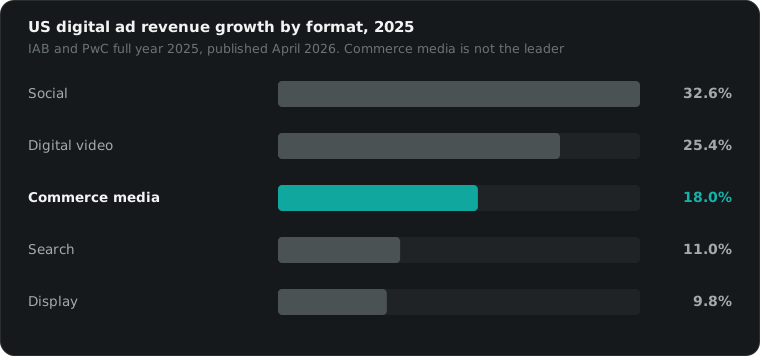
The numbers below come from the IAB and PwC full year 2025 report, published in April 2026. US digital advertising revenue reached $294.6 billion, up 13.9 percent.
| Format | 2025 US revenue | Growth | What it means for a buyer |
|---|---|---|---|
| Social | $117.7bn | 32.6% | Still where creative volume pays fastest |
| Search | $114.2bn | 11.0% | Mature, and increasingly automated |
| Display | $81.6bn | 9.8% | Slowest of the majors |
| Digital video | $78.0bn | 25.4% | Includes CTV, growing faster than commerce |
| Commerce media | $63.4bn | 18.0% | Large, no longer the growth leader |
Is retail media still the fastest growing line?
Not in the most recent published data. US commerce media grew 18 percent in 2025 to $63.4 billion, which is excellent and also slower than social at 32.6 percent and digital video at 25.4 percent. Retail media is now a big, competitive channel rather than the unclaimed land it was in 2021.
That matters because the pitch has not updated with the digital media trends data. Retail media decks still describe an emerging opportunity with cheap inventory. The inventory is not cheap any more, the auctions are dense, and the useful margin has moved from being early to being operationally good.
For a brand selling through Amazon, noon or a Gulf grocery chain, the practical questions are unglamorous. Does the network give you a placement level report. Can you see share of voice by keyword. Can you get incrementality data, or only attributed sales inside their own window. Most regional networks answer no to the third one.
There is a bigger gap I should be honest about. I cannot find a credible published figure for the size of retail media in MENA. Everything circulating traces back to vendor estimates or consultancy summaries with no method attached. So I do not quote one, and neither should anyone selling you a plan.
What happened to signal loss after the cookie survived?
Signal loss got worse, not better, and for a reason nobody planned for. Google kept third party cookies in Chrome in April 2025. Then in October 2025 it retired ten Privacy Sandbox technologies, including Topics, Protected Audience and the Attribution Reporting API. The cookie stayed and the standardised replacement went away.
Google’s own announcement lists all ten and confirms that CHIPS, FedCM and Private State Tokens continue. Attribution work moved to the W3C with no delivery date.
So the position in 2026 is uneven. Chrome still passes a third party cookie. Safari and Firefox still block cross site cookies by default. iOS apps still depend on user opt in. Few digital media trends have been as badly forecast. The industry spent five years building for a deadline that was cancelled, then lost the thing it was building towards.
The practical consequence is that first party data collection stopped being a strategic project and became plumbing. If your purchase events are not reaching Meta and Google from your server, your automated bidding is optimising against a partial picture, and no amount of budget fixes that. This is the part of advertisement tracking that clients still treat as an IT ticket, and it is now the single biggest lever on cost per acquisition.
Does connected TV work in MENA yet?
Connected TV in MENA has real inventory and uneven advertiser demand. MBC Group reported MBC Shahid revenue of SAR 459.9 million for the first quarter of 2026, up 17.5 percent, out of group revenue near SAR 1.6 billion. In the same release the group described softer advertising demand, shorter booking cycles, and a modest decline in advertising revenue.
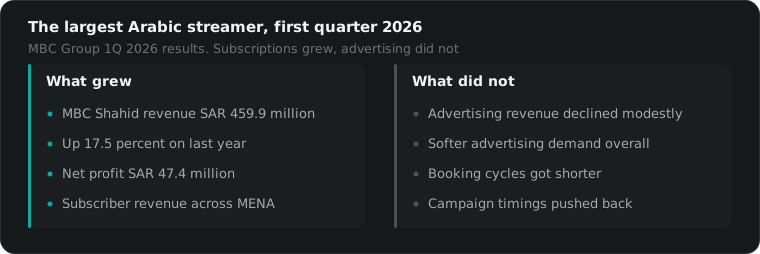
Read that carefully, because it is the most useful single data point in the region. The largest Arabic streaming service grew on subscriptions and pricing, while its advertising line went backwards in the quarter. Both facts are in the same MBC Group announcement.
What that tells a buyer is specific. The audience exists at scale. The ad demand is seasonal and heavily weighted to Ramadan. Booking windows are shortening, which usually means negotiable rates outside peak. Measurement is still household level and genre based, which is contextual advertising by another name.
So plan Gulf connected TV as a reach line with a fixed budget and a reach goal. Do not plan it as a channel you scale weekly on cost per acquisition, because the reporting will not support that argument.
How much of ad buying is really done by AI now?
Most of the bidding, a growing share of targeting, and an increasing amount of creative assembly. Google states that advertisers using AI Max for Search typically see 14 percent more conversions or conversion value at a similar cost per acquisition. Meta reports a 6 percent recall gain and an 8 percent ads quality gain from its Andromeda retrieval system.
Both of those numbers were produced by the company selling the product, measured inside its own platform, against its own baseline. That does not make them false. It makes them unauditable, which is a different problem and the one worth saying out loud.
What I can report from accounts I run is narrower and less exciting. Automated products perform roughly in line with a well built manual campaign when the conversion signal is clean, and noticeably worse when it is not. The variable that changed is the input, not the algorithm. The same shift already happened in programmatic advertising a decade ago.
Of all the digital media trends here, this is the one that changed my week. The job has moved accordingly. Less time in the auction, more time on offer, creative volume and event quality. That is a real change and it is the only AI claim in this post I would defend without a citation, because I watch it happen every month.
Which digital media trends should you ignore?
Ignore any of the digital media trends that cannot be traced to a platform document, an official announcement or a published study. In practice that removes attention metrics sold as a trading currency, most MENA market sizing, and the recurring claim that automation has removed the need for a buyer. None of those three has evidence you can inspect.
- Attention as a currency. The research is interesting and the vendor benchmarks are proprietary. You cannot audit a number you are not allowed to see.
- Regional market sizing. Numbers for MENA retail media and MENA CTV circulate widely and trace back to nothing. Ask for the method once and watch what happens.
- The buyer is obsolete. Automation raised the floor and moved the work. It did not remove the person who decides what to sell, at what price, to whom.
The test is boring and it works. Ask for the source, read it, and see whether the claim survives contact with the document.
What we do about it
We plan against the four things above and ignore the rest. In practice that means fixing server side events before touching channel mix, treating Gulf connected TV as reach rather than performance, and refusing to quote a regional market size we cannot source. It is a slower conversation and a shorter list.
If a supplier hands you a deck full of digital media trends this quarter, the fastest audit is to open every citation. Most decks do not survive it.
You can see exactly what we charge before you speak to anyone, including the percentage at your spend level. If you would rather ask whether any of this changes your plan, 15 minutes will settle it.
Questions people actually ask
Is retail media still the fastest growing ad channel?
Not in the IAB and PwC numbers for 2025. Commerce media in the United States grew 18 percent to $63.4 billion, while social grew 32.6 percent and digital video grew 25.4 percent. Retail media is large and still growing quickly, but the line that it leads all growth stopped being true in the most recent full year of published data.
Did third party cookies actually go away?
No. Google reversed the Chrome deprecation in April 2025 and third party cookies still work there. What changed is that Google retired ten Privacy Sandbox technologies in October 2025, including Topics, Protected Audience and the Attribution Reporting API. Safari and Firefox continue to block cross site cookies by default, so the loss is uneven rather than universal.
Is connected TV worth buying in Saudi Arabia and the UAE?
The inventory is real and the audience is there, but demand is lumpy. MBC Group reported MBC Shahid revenue of SAR 459.9 million in the first quarter of 2026, up 17.5 percent, while noting that advertising revenue declined modestly and that booking cycles had shortened. Treat Gulf connected TV as a reach buy you plan around, not a performance channel you scale weekly.
How much of media buying is automated now?
Most of the bidding and a growing share of targeting and creative assembly. Google states that advertisers using AI Max for Search typically see 14 percent more conversions at a similar cost per acquisition, and Meta reports quality and recall gains from its Andromeda retrieval system. Both figures are measured by the vendor selling the product, which is worth remembering before you plan around them.
Which digital media trends should I ignore in 2026?
Anything with no primary source behind it. That currently includes most attention metric pitches, most MENA retail media market sizing, and the recurring claim that AI has removed the need for a media buyer. If a trend cannot be traced to a platform document, an official announcement or a published study, it is a sales narrative rather than a trend.
What should a small advertiser change this year?
Very little in channel mix and quite a lot in measurement. Fix server side conversion tracking first, because signal quality now decides how well every automated bidding product performs. Then check what share of budget is talking to people who already know you. Those two things move results more than any new channel you could add this quarter.